
When students start exploring digital credentials, they encounter three terms that are related but distinct: Open Badges, Verifiable Credentials, and the Skill Passport. Each plays a different role in building a trustworthy learner record. This guide explains each one clearly.
What Is an Open Badge?
An Open Badge is a digital credential — typically an image file — that represents a specific achievement. Unlike a PDF certificate, an Open Badge contains embedded metadata that can be verified by anyone:
- Who issued the badge (the school, certification body, or organisation)
- Who it was issued to (the learner)
- What it represents (the skill, course, or achievement)
- When it was issued
- Why it was given (the criteria met to earn it)
The Open Badge standard was originally developed by Mozilla and is now maintained by 1EdTech (formerly IMS Global). The current version — Open Badges v3 — is the standard used by SkillStory and is aligned with the W3C Verifiable Credentials specification.
Open Badges can be earned from many sources: schools, universities, online platforms (like Coursera or edX), professional bodies, community organisations, and employers. They can be collected in a digital wallet — which is part of what SkillStory provides.
What Makes a Badge “Open”?
The “open” in Open Badge refers to the open standard — meaning the format is publicly defined and can be used by any organisation, on any platform, and verified by anyone. Open Badges are not proprietary to any single company. A badge issued by a school using one platform can be verified by a university using a completely different system.
What Are Verifiable Credentials?
Verifiable Credentials are a broader technical standard defined by the W3C (World Wide Web Consortium) — the organisation responsible for the technical standards that power the web.
A Verifiable Credential is a digital document that:
- Makes a claim about a subject (“this student completed this course”)
- Is issued by an identified authority (the school or certification body)
- Is cryptographically signed — meaning any alteration after signing is detectable
- Can be verified by anyone with the public key, without contacting the issuer
In plain terms: a Verifiable Credential is a digital certificate that cannot be faked or altered, and that anyone can check is genuine without phoning the school or waiting for an email response.
Open Badges v3 is built on the W3C Verifiable Credentials specification. So an Open Badge is a specific type of Verifiable Credential — designed for educational achievements.
The Simple Chain: Badge → Credential → Verification
Here is how the pieces connect:
A student completes a Python programming course.
- The course provider issues an Open Badge — a digital credential meeting the 1EdTech Open Badges v3 standard
- The badge is a Verifiable Credential — cryptographically signed by the issuer, containing all the relevant metadata
- The student adds it to their SkillStory Skill Passport — where it joins their other achievements, attested records, and learning history
- Any evaluator — a university, employer, or scholarship board — can verify the badge by following the verification link. They see who issued it, when, to whom, and what it represents. They can confirm cryptographically that it has not been altered.
This chain — from achievement through to independent verification — is what makes verified credentials genuinely valuable.
Why This Is Not a Blockchain Story
Blockchain is sometimes associated with digital credentials, and some credential platforms do use blockchain technology. SkillStory does not position its credentials as blockchain-based — and that is worth explaining.
The W3C Verifiable Credentials standard does not require blockchain. Cryptographic signing — the technology that makes credentials tamper-proof — is a decades-old, well-established technology that works without a distributed ledger.
The trust in a SkillStory credential comes from:
- The identity and reputation of the issuer (a named school, teacher, or certification body)
- The cryptographic signature (which makes alteration detectable)
- The open standard (which makes verification universally possible)
This is more relevant to students, parents, and educators than any blockchain discussion. The question is not “which technology was used?” but “can I verify this is genuine?” — and the answer, for every SkillStory credential, is yes.
How Open Badges and Verifiable Credentials Fit Into a Skill Passport
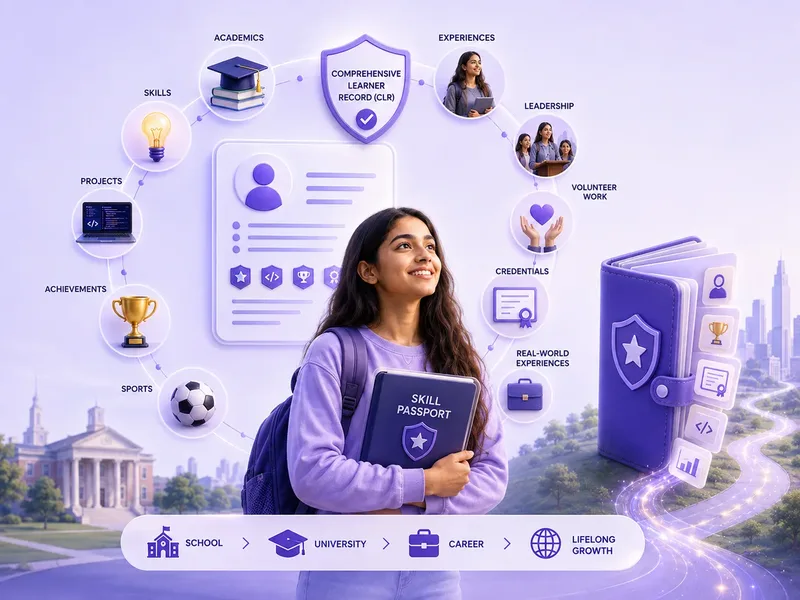
The SkillStory Skill Passport is the record that brings all of this together.
A student’s Skill Passport can include:
- Open Badges earned from school programmes, online courses, and professional bodies
- Attested achievements — achievements that have been digitally signed by a teacher or mentor (these function as Verifiable Credentials under the W3C standard)
- CLR-structured records — the complete learner record in the 1EdTech Comprehensive Learner Record format
- Shareable credentials — individual achievements that can be shared on LinkedIn, in university applications, and on CVs
The Skill Passport is not just a wallet for storing these credentials. It is a curated portfolio and a verified identity — showing not just individual achievements, but the full arc of the student’s capabilities.
Who Issues Credentials in the SkillStory System?
In SkillStory, credentials can be issued by:
- Schools and institutions — through the School License, teachers and administrators can issue Open Badge credentials to students directly
- SkillStory itself — for platform-recognised achievements and programme completions
- Third-party providers — students can import credentials from Coursera, edX, Udemy, LinkedIn Learning, and other platforms that issue Open Badges
And separately, teacher and mentor attestation creates a different type of verifiable record — a signed confirmation of an achievement, tied to the educator’s identity.
Frequently Asked Questions
Do Open Badges expire? Some badges include an expiry date set by the issuer — particularly for qualifications that require regular renewal (like first aid or professional certifications). Most badges do not expire. Expired badges remain in the student’s wallet as a record, clearly marked as expired.
Can students earn Open Badges outside school? Yes — this is one of the most powerful aspects of the system. Badges from online platforms, community organisations, professional bodies, and any Open Badges-compliant issuer can be added to the SkillStory Skill Passport alongside school-issued credentials.
Is my credential data private? Students control which achievements are public on their portfolio and which remain private. The verification link for a specific credential only confirms that credential’s details — it does not expose the student’s entire Skill Passport.
What is the difference between an Open Badge and a certificate PDF? A PDF certificate can be edited in any design tool. An Open Badge is cryptographically signed — any alteration is detectable. A PDF requires the recipient to contact the issuer to verify. An Open Badge can be verified in seconds by anyone with the link.
Key Takeaways
- An Open Badge is a single digital credential — verifiable, portable, and issued to the 1EdTech Open Badges v3 standard
- Verifiable Credentials are the W3C standard that makes digital claims cryptographically tamper-proof
- Open Badges v3 is built on the W3C Verifiable Credentials specification
- A Skill Passport brings all credentials, badges, and attested achievements together in one trusted student-owned record
- Trust comes from open standards, cryptographic signing, and named issuer identity — not from blockchain
Arjun Kapoor writes on digital credentials, learner identity, and the future of professional recognition.