
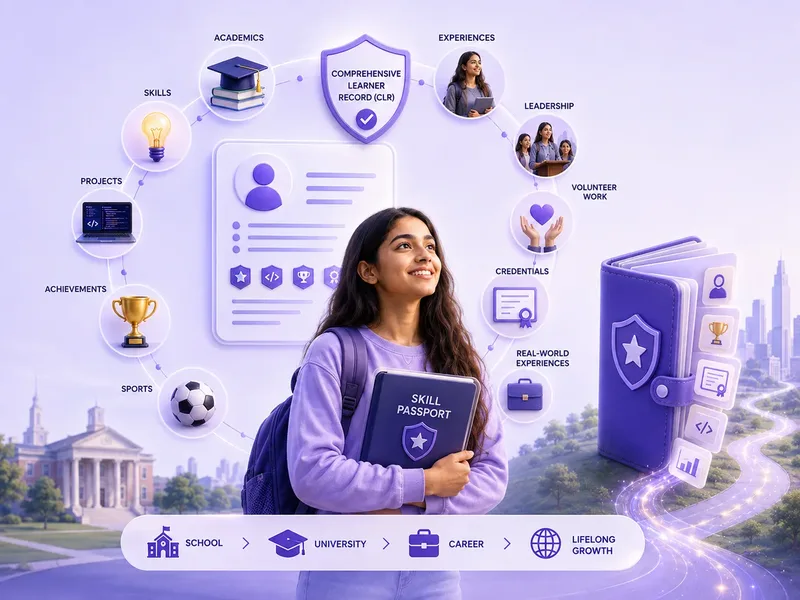
If you have encountered the term “Comprehensive Learner Record” and wondered what it actually means — for your child, for your school, or for your own career — this guide explains it clearly, without the technical jargon.
What Is a Comprehensive Learner Record?
A Comprehensive Learner Record, or CLR, is a structured digital document that captures the complete range of a learner’s achievements — not just formal grades and qualifications, but skills, competencies, experiences, credentials, and extracurricular achievements.
The standard was developed by 1EdTech (formerly IMS Global Learning Consortium), the international organisation responsible for education technology interoperability standards, including SCORM, LTI, and Open Badges. 1EdTech describes the CLR as:
“A customisable digital record covering learning experiences including courses, competencies, skills, internships and Open Badges in verifiable, machine-readable form.”
The key words in that definition are:
- Customisable — it can represent many types of achievement, not just formal grades
- Verifiable — recipients can confirm the record is genuine
- Machine-readable — structured in a way that systems and institutions can process it automatically
Why the CLR Exists
Traditional academic transcripts were designed for a world where learning happened in one institution, was assessed in one way, and was presented to one type of evaluator (another institution).
That world no longer reflects how learning works.
Students today learn from:
- Schools and universities (formal)
- Online platforms and certification bodies (non-formal)
- Work experience and internships (experiential)
- Community programmes and volunteering (informal)
None of these learning pathways — except formal schooling — reliably appear on a transcript. The CLR was designed to include all of them, in a structured format that any evaluator can understand and verify.
What a CLR Can Include
A CLR built to the 1EdTech standard can contain:
| Achievement Type | Examples |
|---|---|
| Courses | School subjects, university modules, online courses |
| Competencies | Defined skill frameworks, occupational standards |
| Skills | Technical and transferable skills, attested by educators |
| Credentials | Open Badges, digital certificates, professional qualifications |
| Achievements | Awards, competition results, recognitions |
| Experiences | Internships, work placements, volunteer programmes |
| Extracurricular | Sports, arts, leadership roles, community contributions |
This breadth is the point. A CLR is designed to capture the full picture of the learner — not just what was tested.
How the CLR Relates to Open Badges
Open Badges and CLRs are related but distinct.
An Open Badge is a digital credential representing a single achievement — a certificate for a course, a badge for a skill, a recognition for a competition. Each badge contains verifiable metadata: who issued it, to whom, when, and why.
A CLR is the container — a structured record that can include many Open Badges alongside other achievement types. Think of Open Badges as individual verified achievements, and the CLR as the wallet that holds and organises them, alongside everything else the learner has done.
Both standards are maintained by 1EdTech. Both are built into the SkillStory Verified Credentials system.
Why Machine-Readability Matters
“Machine-readable” means that the data in a CLR is structured in a way that software systems can parse, process, and verify automatically — without a human needing to read and interpret a document.
This matters for three reasons:
1. Automated verification An employer’s or university’s system can check the authenticity of a CLR electronically, without sending emails or making phone calls.
2. Cross-platform portability Because the CLR follows a defined standard, it can be understood by any system that supports the standard — not just the platform where it was created.
3. AI-era relevance As AI systems are used to review applications, structured and machine-readable records become more important. A document scanned as a PDF is harder for AI to process reliably than a structured, standardised CLR.
How SkillStory Implements the CLR Standard
The SkillStory Skill Passport is built on the 1EdTech CLR standard. This means:
- Every achievement in a student’s Skill Passport is structured in CLR-compliant format
- Teacher and mentor attestations are recorded as verifiable assertions within the CLR framework
- Open Badge credentials issued through SkillStory conform to Open Badges v3
- The complete record can be exported in CLR format for sharing with universities, employers, or any CLR-compatible system
SkillStory did not invent the CLR — 1EdTech did. SkillStory implements it for students, making a complex technical standard accessible as a practical product that students can use from school age onwards.
What This Means for Schools
Schools that join SkillStory gain the ability to issue CLR-compliant learner records to their students. This is increasingly significant as:
- Universities develop CLR-compatible admissions workflows
- Employers ask for structured digital credentials rather than paper certificates
- Education regulators and quality bodies encourage more comprehensive learner documentation
A school that can provide every student with a CLR-compliant Skill Passport is offering something qualitatively different from a school that provides only a transcript.
What This Means for Students and Parents
For students and parents, the practical implication is straightforward: a SkillStory Skill Passport is built on the same international standard that leading universities and credential platforms use. It is not a proprietary format that becomes obsolete when a platform shuts down — it is a structured, open record that can travel with the student indefinitely.
When a student shares their SkillStory Skill Passport URL with a university, the admissions team is receiving a CLR-compliant, verifiable learner record — not a PDF or an unverified profile.
Frequently Asked Questions
Did SkillStory create the CLR standard? No. The CLR standard is maintained by 1EdTech (formerly IMS Global Learning Consortium), an independent education technology standards organisation. SkillStory implements the CLR standard as the technical foundation of its Skill Passport product.
Do I need to understand the technical details of CLR to use SkillStory? No. The CLR standard operates in the background. Students and parents experience SkillStory as a simple platform for recording, verifying, and sharing achievements — the CLR structure is what makes those records universally readable and verifiable.
Can CLR records be used outside SkillStory? Yes. Because CLR is an open standard, records exported from SkillStory can be used with any institution or employer that supports the CLR format. The standard is specifically designed to prevent learner records from being locked into any single platform.
Are CLRs recognised by universities? Many universities — particularly in the US, UK, Europe, and Australia — are developing CLR-compatible workflows for admissions and verification. Adoption is growing as the standard matures. Even without formal CLR integration, any institution with a web browser can verify a SkillStory Skill Passport via the public verification link.
Key Takeaways
- A Comprehensive Learner Record (CLR) is an open standard for capturing all types of learning achievement in a verifiable, machine-readable format
- It was created by 1EdTech (formerly IMS Global) — the organisation behind global education technology standards
- CLRs go beyond grades to include skills, experiences, credentials, and extracurricular achievements
- SkillStory implements the CLR standard as the technical foundation of its Skill Passport
- Machine-readability and open standards ensure that CLR records are portable, durable, and verifiable across institutions
Dr. Priya Sharma is an education technology specialist with experience in digital credentialing and learner record systems.