
When students and parents first encounter the concept of a Skill Passport, the most common question is: “How is this different from a portfolio or a CV?”
It is a fair question. The terms are sometimes used interchangeably — which does not help. Here is a clear-eyed comparison of what each format is, what it can do, and why the differences matter.
The Resume: A Formatted Summary
A resume (or CV) is a structured document that summarises a person’s education, work history, skills, and achievements in a standardised format.
What it does well:
- Provides a scannable, formatted overview
- Is universally expected in job applications
- Can be tailored for different audiences
- Communicates professional history efficiently
What it cannot do:
- Verify a single claim — everything on a resume is self-reported
- Carry evidence of the skills it lists
- Be updated continuously as a living record
- Provide a verification mechanism for anyone who receives it
A resume says “I have these skills and did these things.” There is no mechanism built in for anyone to confirm whether that is true.
This is not an accusation of dishonesty. It is a structural limitation. And in a hiring and admissions landscape where AI tools can generate plausible-sounding CVs instantly, the absence of verification is becoming a meaningful weakness.
The Portfolio: Work Samples and Evidence
A portfolio is a curated collection of work samples — documents, designs, code repositories, presentations, recordings, or any other artefact that demonstrates what the creator can produce.
What it does well:
- Shows rather than tells — actual work, not claims about it
- Is highly persuasive for creative and technical disciplines
- Can be tailored for different opportunities
- Works well alongside a resume or application
What it cannot do:
- Verify that the work shown is genuinely the student’s own
- Provide credentials or attestations from trusted authorities
- Follow a standard format that evaluators can rely on
- Offer a continuous, date-stamped, tamper-proof record
A portfolio raises the question: “How do I know this is genuine?” Without verification, a portfolio is still largely self-reported — better than a bullet point, but not independently trustworthy.
The Skill Passport: Verified, Lifelong, Student-Owned
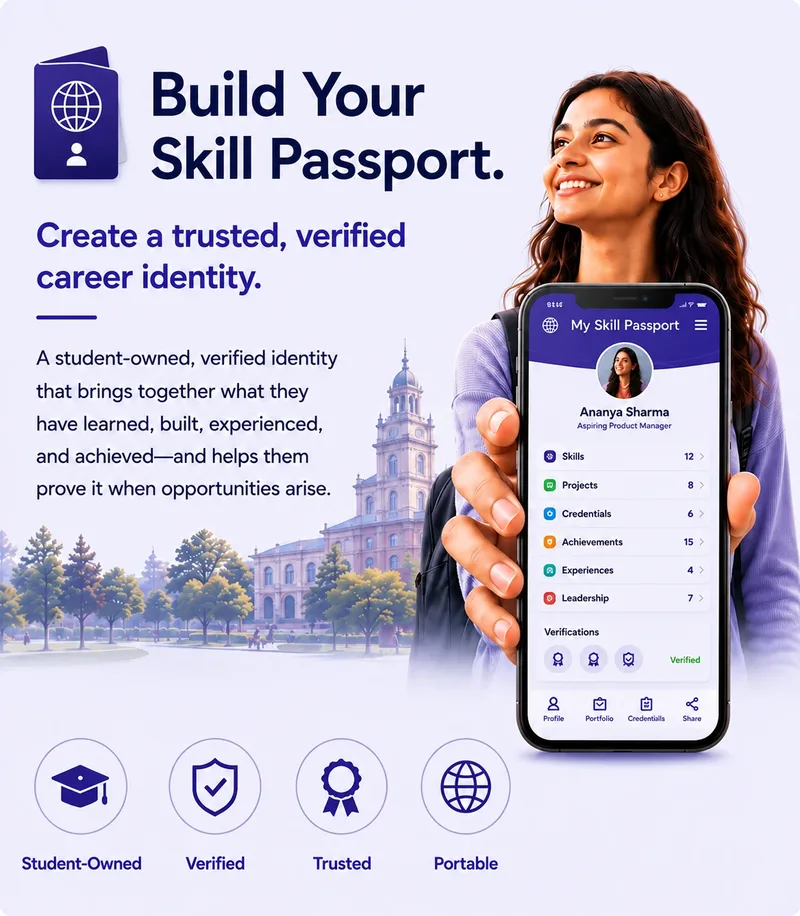
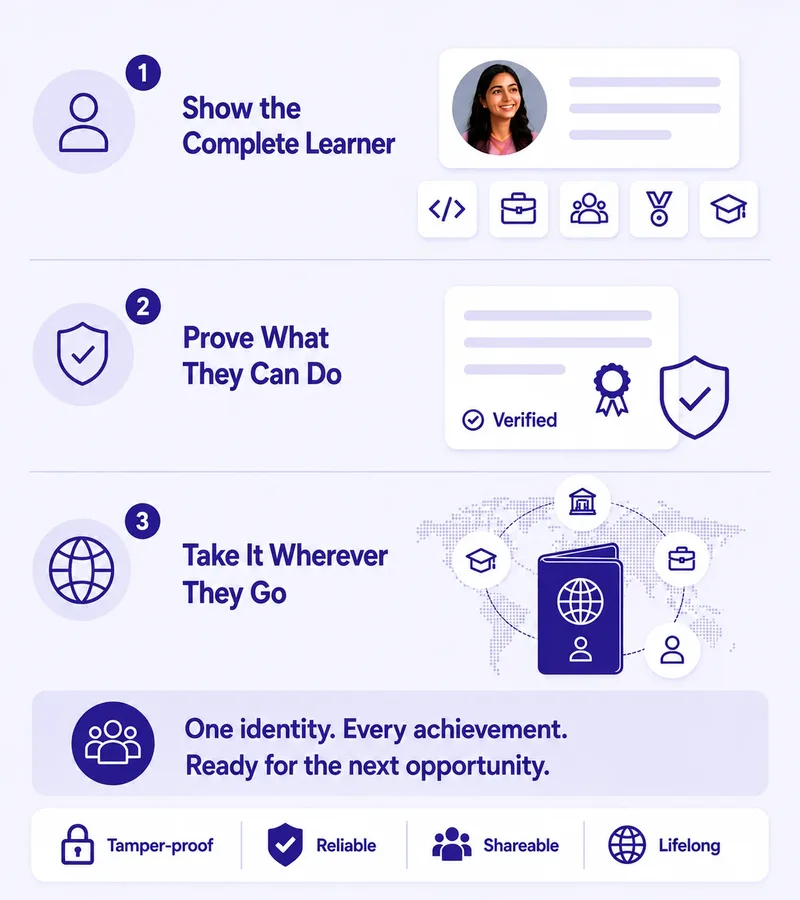
A Skill Passport combines the breadth of a CV, the evidence of a portfolio, and adds the one element neither provides: independent, cryptographic verification.
Every achievement in a SkillStory Skill Passport can be:
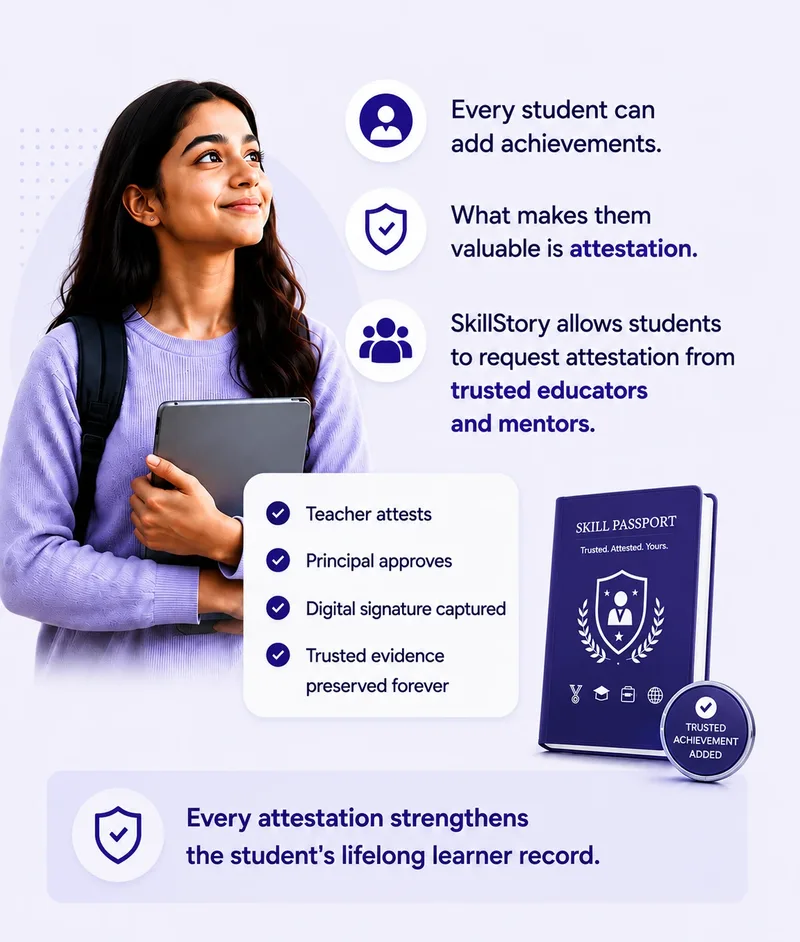
- Attested by a named teacher, mentor, or principal with a digital signature
- Verified via a public link — by anyone, without creating an account
- Exported as a standardised credential (Open Badge v3 or CLR) that is portable across platforms and institutions
- Maintained as a continuous, lifelong record — not a document that gets refreshed before each application
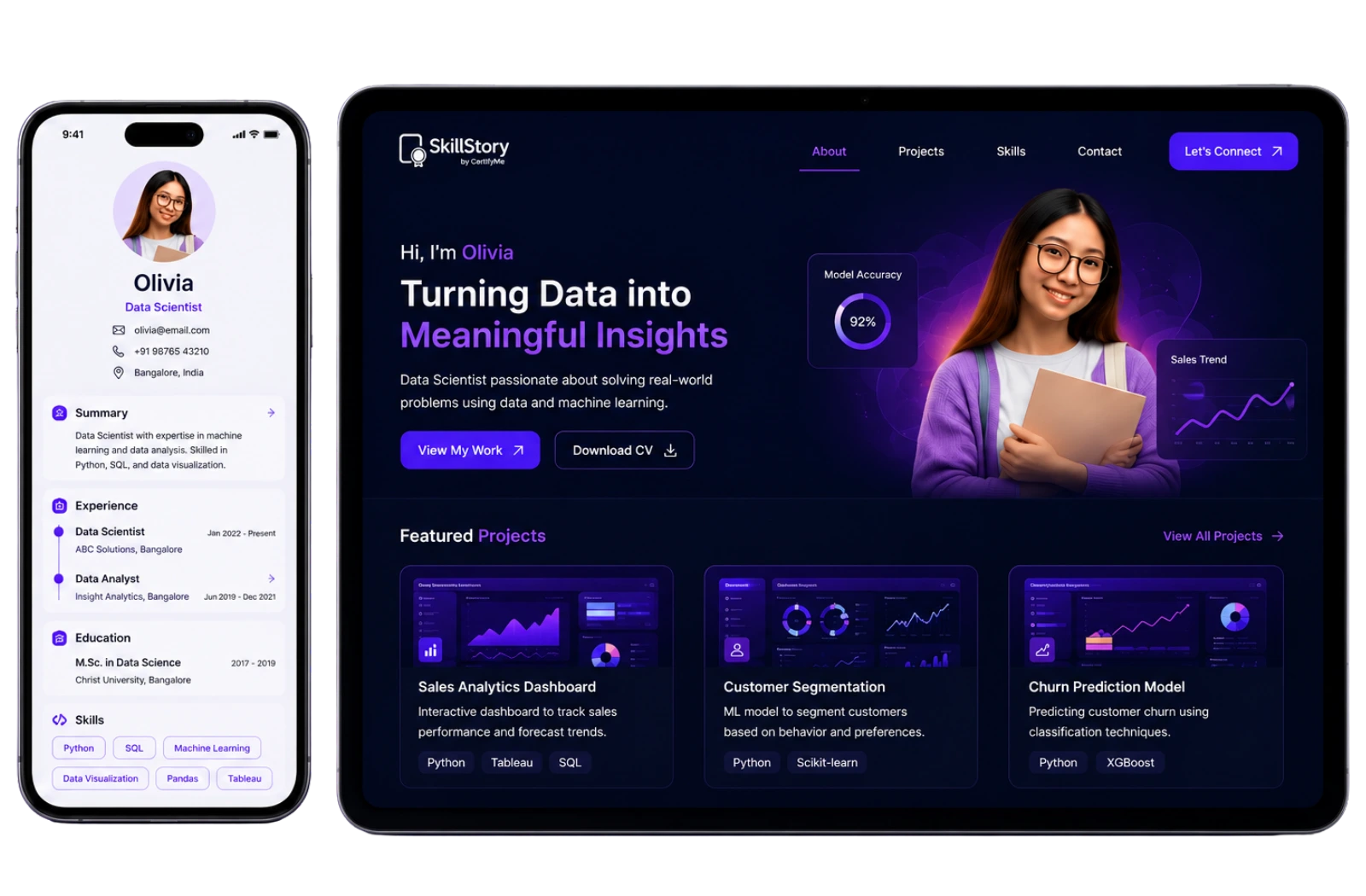
The Skill Passport does not replace a resume or a portfolio. It underpins both. When a student shares their SkillStory profile, the reviewer sees skills (resume-style), evidence (portfolio-style), and verification (something neither provides alone).
The Comparison Table
| Resume | Portfolio | Skill Passport | |
|---|---|---|---|
| Skills listed | ✓ | ✓ | ✓ |
| Work samples / evidence | Limited | ✓ | ✓ |
| Verification of claims | ✗ | Rare | ✓ |
| Teacher / mentor attestation | ✗ | ✗ | ✓ |
| Digital credentials & badges | Limited | Sometimes | ✓ |
| Tamper-proof record | ✗ | ✗ | ✓ |
| Lifelong ownership | ✗ | Sometimes | ✓ |
| Open global standards | ✗ | ✗ | ✓ |
| Shareable via URL | Sometimes | Sometimes | ✓ |
| Works from school age | Limited | Yes | ✓ |
When Each Format Is Appropriate
The answer is not “always use a Skill Passport instead of a resume.” The answer is “each has a role — and the Skill Passport makes the others stronger.”
Use a resume when:
- Applying to positions that require a formal CV document
- Formatting experience for a specific ATS (applicant tracking system)
- Providing a one-page summary to a recruiter or employer
Use a portfolio when:
- Applying for creative, design, or technical roles where work samples are the primary evidence
- Showcasing projects as part of a university application
- Demonstrating range and depth in a specific discipline
Use a Skill Passport when:
- Providing a verifiable, comprehensive record to a university, scholarship body, or employer
- Including a URL in a resume or application that links to verified credentials
- Building a continuous record across years of school and education
- Sharing your complete learner identity — not just work samples or job history
In practice, the strongest student applications include all three: a tailored resume for the specific opportunity, a portfolio for the relevant work, and a SkillStory Skill Passport URL that provides the verified, complete record.
Why Verification Is the Key Difference
A resume makes claims. A portfolio shows examples. A Skill Passport provides proof.
That distinction matters more as competition intensifies and employers and universities develop more sophisticated approaches to evaluating candidates.
In the SkillStory system, teacher attestation is what creates this proof layer. When a chemistry teacher digitally signs confirmation that a student developed and presented independent research, that confirmation is:
- Tied to a named professional identity
- Cryptographically sealed — it cannot be altered
- Timestamped — everyone knows when it was given
- Publicly verifiable — any evaluator can check it instantly
No resume or portfolio entry can make that claim.
Frequently Asked Questions
Should students abandon their resume in favour of a Skill Passport? No. The resume remains a standard document for job and university applications. The Skill Passport complements it by providing the verified evidence behind the resume’s claims.
Can a Skill Passport be shared instead of a portfolio? Yes — and the Portfolio & Showcase feature in SkillStory provides a portfolio-style view of the Skill Passport, shareable via URL with a professional presentation.
Is a Skill Passport accepted everywhere? The Skill Passport is built on open standards (CLR, Open Badges v3) designed for portability. Evaluators do not need any special software to view and verify it — just a web browser and the verification link.
Can employers request verification directly? Yes. Every attested achievement in a SkillStory Skill Passport includes a public verification link. Any evaluator can follow that link to confirm the achievement details, the attesting educator, and the cryptographic integrity of the record.
Key Takeaways
- A resume summarises history; a portfolio shows evidence; a Skill Passport verifies capability
- The critical difference is the trust layer: attestation and cryptographic verification that neither a resume nor a portfolio provides
- The three formats are complementary — the Skill Passport underpins and strengthens both
- Students who can share a verified learner record alongside a tailored resume are stronger candidates
Arjun Kapoor writes on digital credentials, learner identity, and the future of professional recognition.