
Thousands of students applying to the same university programme make the same claims: leadership experience, project involvement, community contribution, technical skills. Admissions teams and scholarship committees know that most of these claims are genuine — but they have no systematic way to distinguish the genuine from the exaggerated.
Verified achievement changes this.
When a student’s record includes independent attestation from a teacher, a cryptographically signed credential, or a live verification link that any evaluator can check, their application carries a different weight. Not because their achievements are greater — but because they can be confirmed.
The Trust Chain: From Achievement to Verified Record
Step 1 — Achievement
The student completes something real: builds a project, leads a team, earns a certification, volunteers in a community programme, wins a competition, or develops a skill through sustained practice.
Without documentation, this achievement exists only in the student’s memory and perhaps a teacher’s recollection.
Step 2 — Evidence
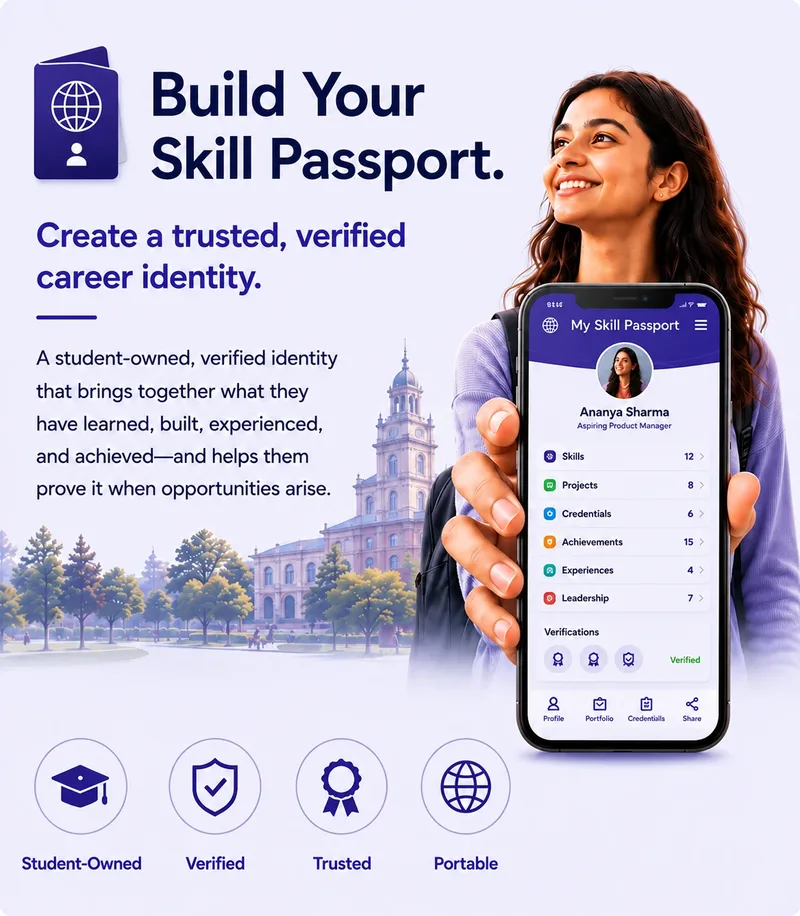
The student records the achievement in their SkillStory Skill Passport with supporting evidence: a description, dates, outcomes, any relevant documents, photos, or links.
Evidence transforms a claim from memory into a documented record. It is still self-reported at this stage — but it is structured, specific, and time-stamped.
Step 3 — Attestation
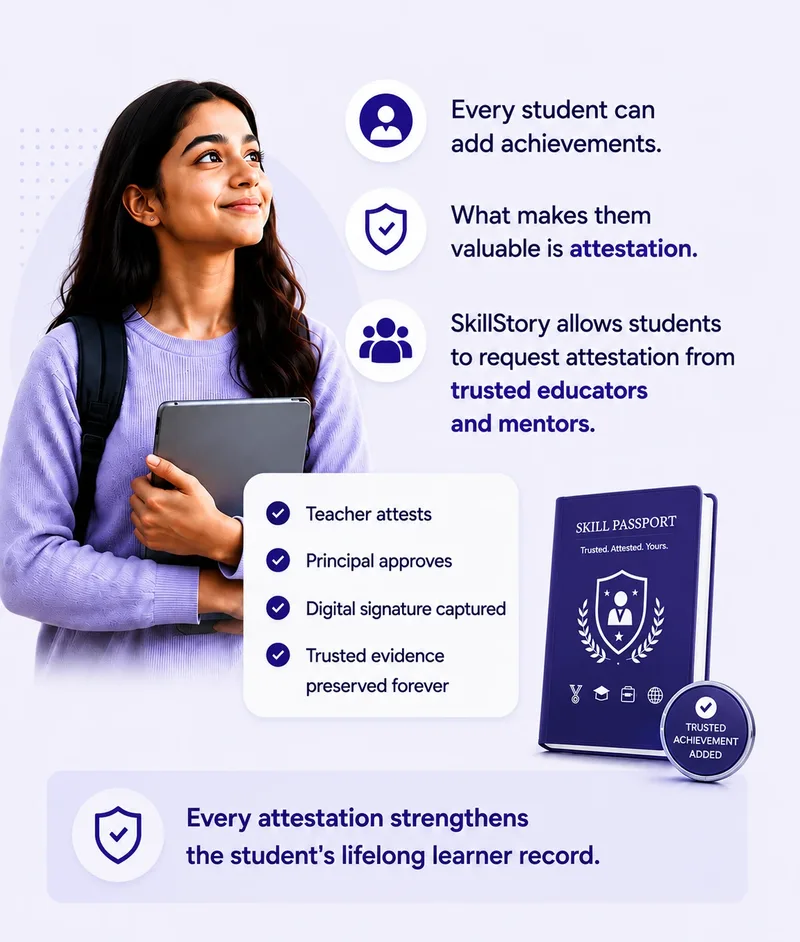
The student requests attestation from a trusted educator — a teacher, principal, coach, or mentor who has direct knowledge of the achievement.
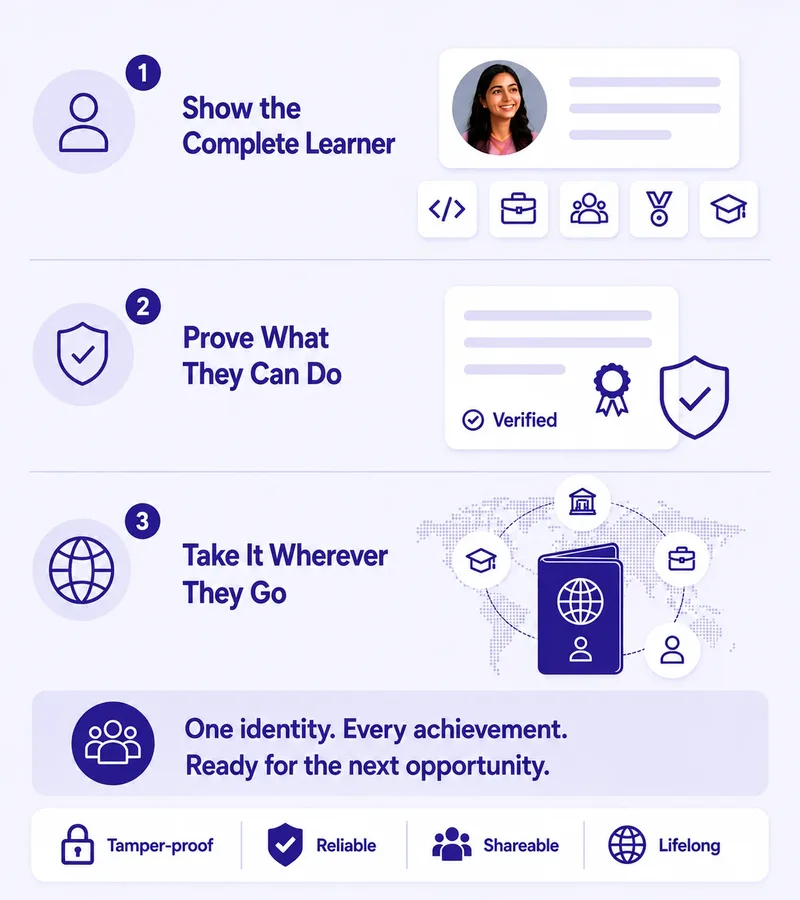
The educator reviews the evidence submitted by the student and, if satisfied, digitally signs their confirmation. This signature is cryptographic: it cannot be altered, removed, or transferred. The attesting educator’s name and role are permanently attached to the record.
This step is what separates a claim from evidence. A teacher’s digital signature does not just confirm the fact — it puts a named professional’s credibility behind it.
Step 4 — Verification
Every attested achievement in SkillStory includes a public verification link. Any evaluator — an admissions officer, a scholarship committee member, an internship coordinator — can follow this link to:
- See the achievement details
- Confirm the attesting educator’s name and role
- Verify that the record has not been altered since signing
- Confirm the date on which the attestation was given
No login is required. No emails to the school. No waiting for a reference letter to arrive.
Step 5 — Trusted Record
The result is a learner record that evaluators can trust — not because they know the student or the school, but because the system of verification is independently checkable.
Why This Matters for University Applications
University applications — particularly for competitive programmes — receive hundreds or thousands of submissions. Personal statements all say similar things. Reference letters follow predictable patterns.
What cuts through is specificity and evidence. An application that includes a link to a verified Skill Passport — with attested projects, signed credentials, and verifiable achievements — provides admissions teams with something they can actually check.
This does not guarantee an offer. It does guarantee that the student’s record is considered with more weight than an unverified personal statement claim.
Consider two personal statement sentences:
“I developed strong leadership skills as captain of the school science team.”
vs.
“I led the school science team to a regional finalist position in 2025 — you can verify this achievement, and my teacher’s attestation, at [skill-passport-link].”
The first is a claim. The second is evidence.
Why Verified Achievements Matter for Scholarships
Scholarship selection is intensely competitive, and scholarship committees are acutely aware of the gap between what students claim and what can be confirmed.
Verified achievements address this directly. A student whose record shows:
- A community volunteer programme, attested by the programme coordinator
- A data science certification from a recognised provider
- A school award, timestamped and signed by the principal
…is making a qualitatively different application from a student who lists the same achievements without verification.
The scholarship committee’s question — “is this genuine?” — is answered before they ask it.
Why Internship Coordinators Are Increasingly Seeking Verification
For internship programmes — particularly at technology, finance, and consulting firms — the ability to verify claims before an interview saves significant time and reduces hiring errors.
A student whose SkillStory Skill Passport includes:
- Attested project experience in the relevant domain
- Open Badge credentials from technical courses
- Teacher confirmation of specific skills demonstrated in school
…arrives at the application process with a pre-verified evidence set. The internship coordinator’s assessment begins from a position of confirmed facts, not unverifiable claims.
The Standard That Makes This Possible
The verification layer in SkillStory is built on established open standards:
- IMS Global CLR — the Comprehensive Learner Record standard, which defines how learner records should be structured and shared across institutions
- Open Badges v3 — the global standard for digital credentials, defining how achievements should be represented, issued, and verified
- W3C Verifiable Credentials — the web standard for cryptographic verification of digital claims
These are not proprietary SkillStory formats. They are the same standards adopted by universities, credential platforms, and employers globally. See the Verified Credentials feature page for more detail on how they work.
Frequently Asked Questions
Do universities formally recognise SkillStory credentials? The Skill Passport is built on open standards that are designed for institutional recognition. Many universities and employers already have workflows for receiving and checking Open Badge credentials. The verification link works with any web browser — no special integration is required.
How many attestations does a student need? There is no minimum. Every genuine attestation adds credibility. Students with one strong attestation from a respected teacher have more than students with none. Building towards three to five attested achievements before a major application is a reasonable target.
Can a student request attestation from someone outside school? Yes — a community programme leader, a sports coach, a volunteer coordinator, or a professional mentor can all attest achievements relevant to their knowledge of the student. The attesting person receives an email with a simple verification request and does not need a SkillStory account to complete it.
What if a teacher declines to attest? The student’s record is not damaged. Unattested achievements remain visible as student-reported entries — clearly distinguished from attested ones. The student can revise their evidence and request again, or ask a different eligible attester.
Key Takeaways
- Verified achievements carry a fundamentally different weight than self-reported claims
- The trust chain — achievement, evidence, attestation, verification, trusted record — is what a SkillStory Skill Passport creates
- Universities, scholarship committees, and internship coordinators benefit directly from being able to verify claims before making decisions
- Open standards ensure that verification works universally, without special software or institutional agreements
Sarah Mitchell is a career education advisor who works with schools and universities on employability frameworks and learner record systems.