
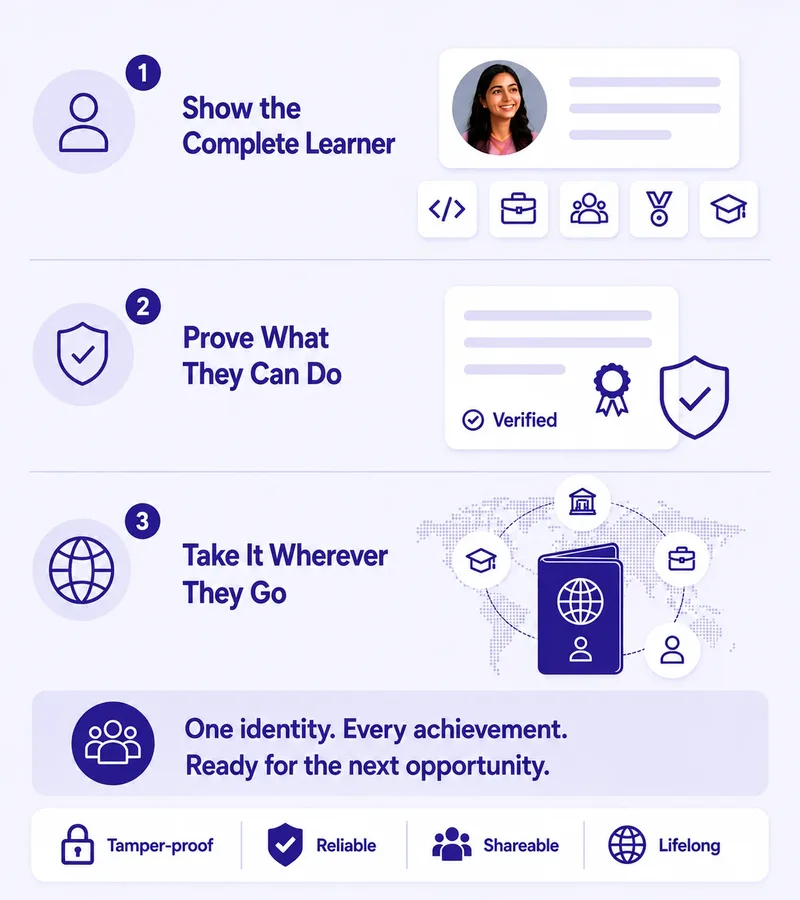
Every parent wants to give their child the best possible start. The investment they make in education, coaching, after-school activities, and development opportunities is real — but often invisible. When a scholarship committee, university admissions team, or internship coordinator reviews an application, they see none of it. They see grades and, if they are lucky, a personal statement that tries to describe it in a few hundred words.
The Skill Passport changes this. It makes the investment visible, verified, and compelling.
The Problem Parents Are Solving
Most parents recognise, instinctively, that their child is more than their grades.
They have watched their child lead a group science project and handle conflict maturely. They have seen them persist through a difficult mathematics topic until they understood it. They know about the coding projects built on weekends, the community service done voluntarily, the languages practised without being asked.
None of this appears on a transcript. And when application season arrives, the student is left trying to describe years of genuine development in a personal statement that many evaluators will skim in under two minutes.
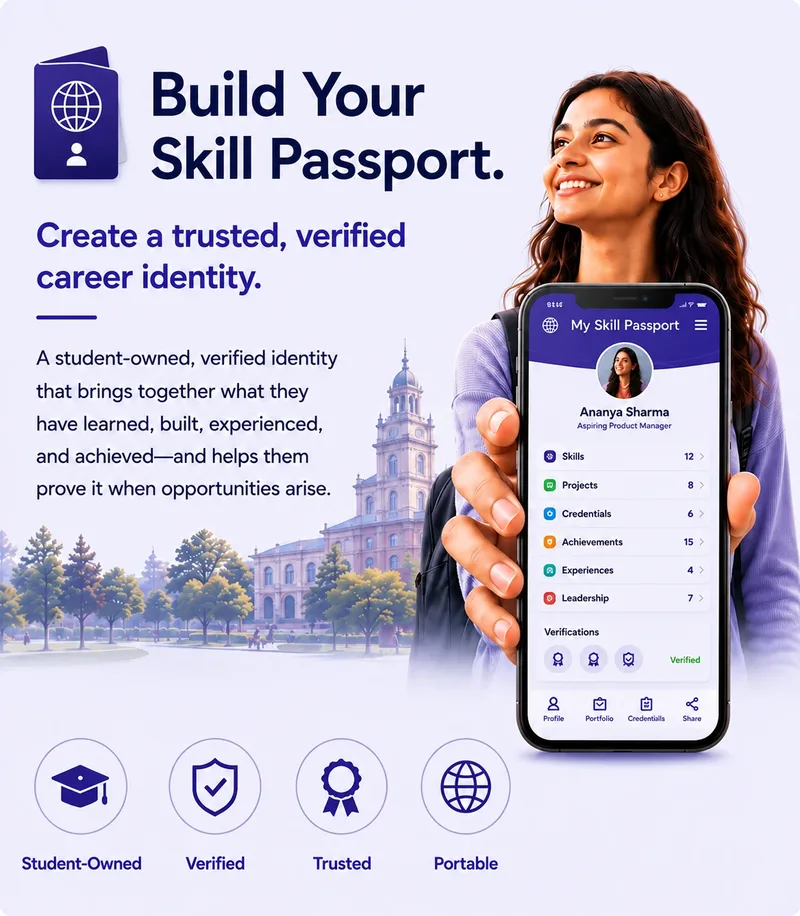
The Skill Passport is the structure for capturing this development as it happens — verified, documented, and ready for any opportunity.
Why Starting Before College Matters
The most common mistake is treating the Skill Passport as an application-season product. It is not. It is a living record that grows in value with time.
Consider what a child’s Skill Passport can look like at different stages:
Age 10 — The Foundation
- School project on local history, with teacher acknowledgement
- Completion of a junior coding course online
- Participation in a school science fair
- First certificates from after-school clubs
These are modest entries. They matter because they establish the beginning of a story — and because the habit of recording and reflecting on achievement starts now.
Age 12 — Building Direction
- Mathematical competition placement, attested by the maths teacher
- Coding project uploaded to a public repository with working demonstration
- Spanish language certificate from a recognised provider
- First leadership role — class representative or club captain
- Volunteer reading assistance at the local primary school
Now the record is starting to show character: initiative, direction, contribution.
Age 14 — Deepening Skills
- Advanced certifications in a chosen technical or creative domain
- A project with real-world impact (app with users, campaign with measurable outcomes)
- Sports or arts achievement, with coach or teacher attestation
- Community initiative the child started or meaningfully contributed to
The Skill Passport now tells a coherent story about what this young person cares about and what they can do.
Age 15 — Demonstrating Capability
- First internship or structured work experience, with employer attestation
- Research project or extended study, attested by a subject teacher
- Award or recognition from a competition or programme
- Peer teaching or tutoring, confirmed by the teacher they supported
At this stage, evaluators begin to see a student who has been building deliberately — not just attending school but actively developing capability.
Age 16–17 — University Application Ready
- Substantial verified project work in the area of intended study
- Multiple teacher attestations across different subjects and educators
- Credentials from recognised providers in the relevant field
- A clear narrative of growth — from early curiosity to developed, evidenced capability
The difference between this student and one who assembled a CV in the final term is not just quantity. It is the arc — the visible story of growth, verified by named professionals across years.
Age 18+ — Career Begins The Skill Passport does not stop at university application. It grows with the student through university, graduate life, and career transitions. Every internship, research project, certification, and professional achievement can be added. The record that began at age 10 is now a lifelong professional identity.
What Parents Can Do Right Now
1. Start the Skill Passport
Create a SkillStory account for your child today. The Student Plan starts at $2.99/month globally (₹99/month in India), billed annually. This is less than the cost of a single after-school class — but it creates the structure for documenting all of them.
2. Review what already exists
Think back over the last year. What has your child achieved? Projects completed, courses taken, roles held, awards received, volunteer work done. Every genuine achievement is worth recording.
3. Identify the adults who know your child’s work
Which teachers, coaches, or mentors have seen your child demonstrate something genuinely notable? Those are the people who can provide attestation. The earlier you establish these attestation relationships, the richer the record becomes.
4. Build the habit of reflection
Once a month, sit with your child and review: what was completed this month? What was learned? Is there anything worth documenting? This takes fifteen minutes and builds one of the most valuable metacognitive skills a student can develop.
5. Focus on genuine achievement, not box-ticking
The brief says it plainly: the most compelling Skill Passports are built from genuine work, honestly described. A student who built something real, helped someone genuinely, or learned something deeply — and who can say so with evidence and a teacher’s confirmation — is more compelling than one with a list of impressive-sounding but thin entries.
A Note for Parents in India
In India’s competitive education landscape — where lakhs of students sit the same board examinations and apply to the same top institutions — the Skill Passport offers a meaningful differentiator.
Top Indian universities and IITs are increasingly looking beyond marks. Scholarship programmes — from national scholarships to international opportunities — want to see demonstrated capability, not just exam scores. Multinational employers hiring from Indian universities want evidence of applied skill.
The SkillStory Skill Passport, at ₹99/month billed annually, makes this kind of verified learner record accessible — not just for students in premium schools, but for any student with genuine achievements worth documenting.
What the Skill Passport Is Not
It is not a guarantee of admission, employment, or scholarship.
It is not a product that compensates for weak academic performance.
It is not a way to exaggerate or manufacture achievements.
It is a way to make genuine achievement visible — to ensure that the years of investment, effort, and growth that parents see in their children can be seen, verified, and valued by the people who make decisions about their futures.
Frequently Asked Questions
What age is right to start? As early as 10–11 years old, when children start producing meaningful projects and participating in activities worth documenting. There is no minimum age — any genuine achievement is worth recording.
What if my child is already in Year 11 or 12? Start now. Even a Skill Passport built over the final two years of school is more compelling than none. The most important thing is to be honest, specific, and to seek attestation for the most significant achievements.
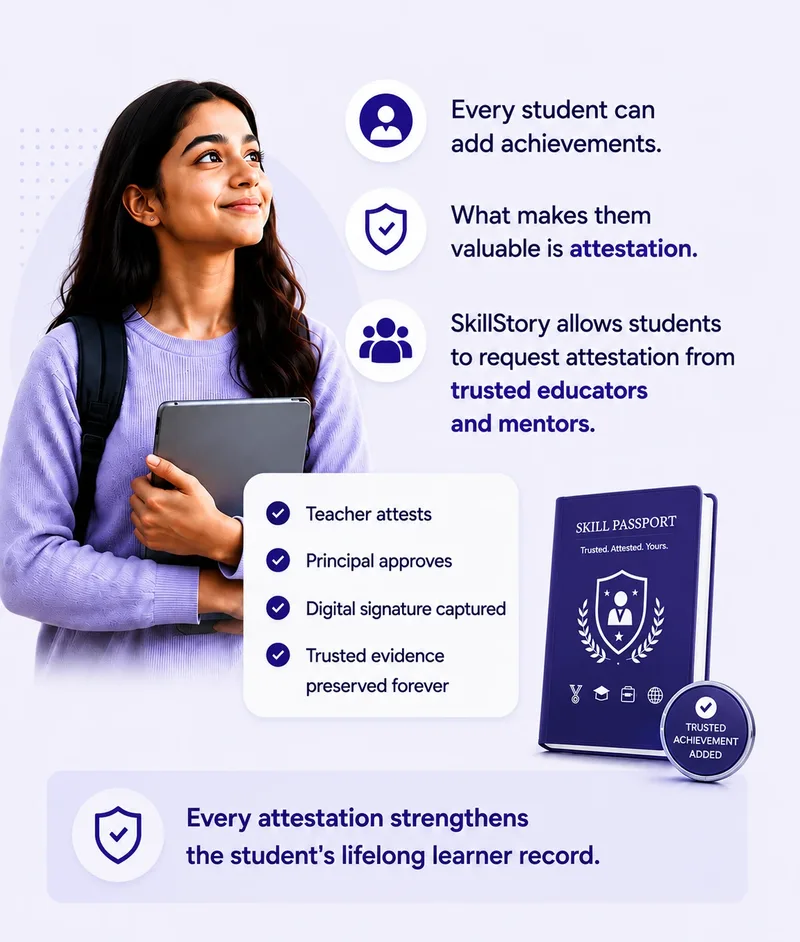
Do we need the school to be involved? No. Individual students and parents can create a Skill Passport without any school involvement. Teachers can be asked to attest achievements by email — they do not need a SkillStory account to complete the process.
Is the Skill Passport recognised in India? The Skill Passport is built on open international standards (CLR, Open Badges v3) recognised by institutions and credential platforms globally. Indian universities and employers reviewing it receive a URL with a complete verified record and can follow verification links for any individual achievement.
Can my child’s Skill Passport be shared as part of a university application? Yes. The Skill Passport is accessible via a shareable URL. Students include this in applications, emails, and personal statements. Recipients can view and verify the complete record without creating any account.
Key Takeaways
- A Skill Passport started early produces a compounding record of genuine capability — far stronger than one assembled under application pressure
- Parents can document what they already know about their child’s achievements and request attestation from the teachers who know their child’s work
- The SkillStory Skill Passport makes investment in a child’s development visible, verified, and compelling to evaluators
- Starting at age 10 and building consistently through school produces a qualitatively different result from starting at 17
- The record does not end at school — it grows with the student through university and into career
Dr. Priya Sharma is an education technology specialist with experience in digital credentialing and learner record systems.