
Imagine two students. Both receive a B+ in computer science. One has spent two years building side projects, contributing to open source, and earning certifications in machine learning. The other memorised the curriculum and passed the exam.
Their grades are the same. Their capability is not.
This gap between academic assessment and actual capability is one of the most significant — and most solvable — problems in education and hiring.
What Grades Actually Measure
Grades are designed to measure a specific thing: how well a student performed on assessed components of a curriculum, in the conditions defined by the examination.
This is useful. It is not unimportant. Academic results signal:
- Capacity for structured learning
- Discipline and consistent effort
- Comprehension of a defined body of knowledge
- Performance under assessment conditions
These qualities matter. No credible argument for the Skill Passport involves dismissing grades.
The argument is simpler: grades alone do not capture the full picture. And in a world where universities and employers have access to more sophisticated signals of capability, the students who provide only grades are at a disadvantage.
What Grades Cannot Measure
Consider what never appears on a transcript, no matter how strong the student:
- The app they built and launched to real users
- The science project that won a regional competition
- The year they spent tutoring younger students in mathematics
- The certification they completed independently, outside school
- The community initiative they started from scratch
- The way their teacher describes their ability to collaborate under pressure
Each of these signals something that a grade cannot: applied capability, initiative, and real-world evidence of skill.
The Shift Underway in Hiring and Admissions
Three trends are converging to make the gap between grades and capability more consequential:
1. Skills-based hiring is accelerating
Major employers — including technology, finance, and consulting firms — have removed degree requirements from large portions of their job listings. What they require instead is demonstrable skill. IBM, Google, Apple, Accenture, and many others have made public statements about this shift.
2. Universities want more than transcripts
Leading universities increasingly describe what they are looking for in personal statements and application guidance: evidence of curiosity, initiative, contribution, and capability beyond academic results. “Show us what you have done” is becoming as important as “show us your grades.”
3. AI is making generic knowledge easier to produce
If an AI tool can generate a competent essay on any topic in seconds, the value of an essay grade changes. What does not change is the value of evidence that a student can actually do something — build, create, lead, demonstrate.
What Fills the Gap
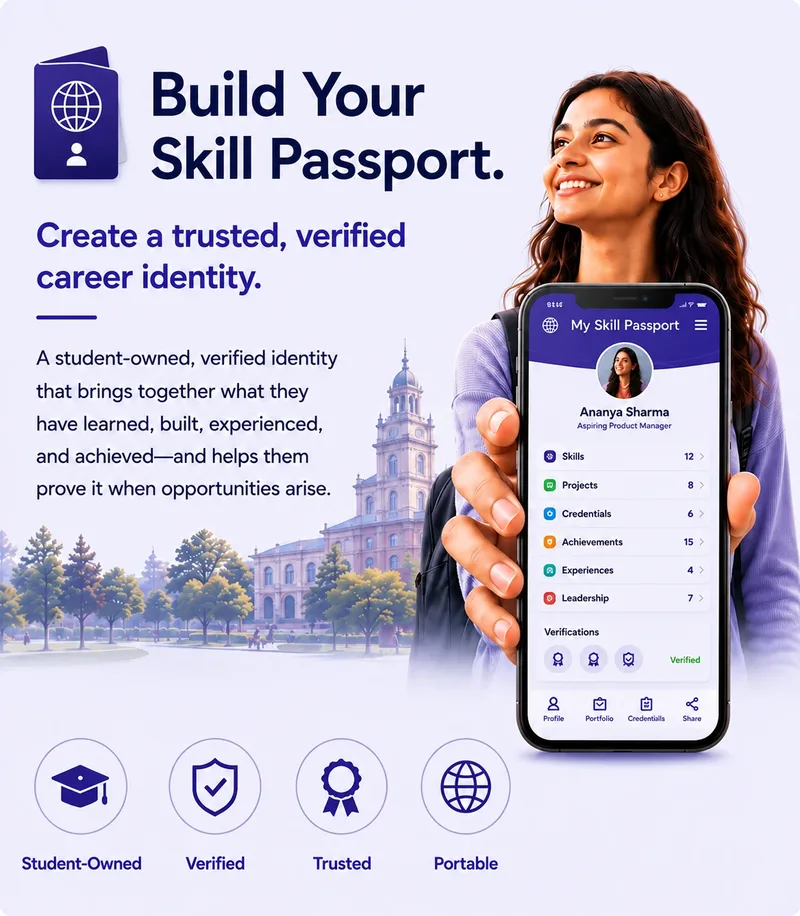
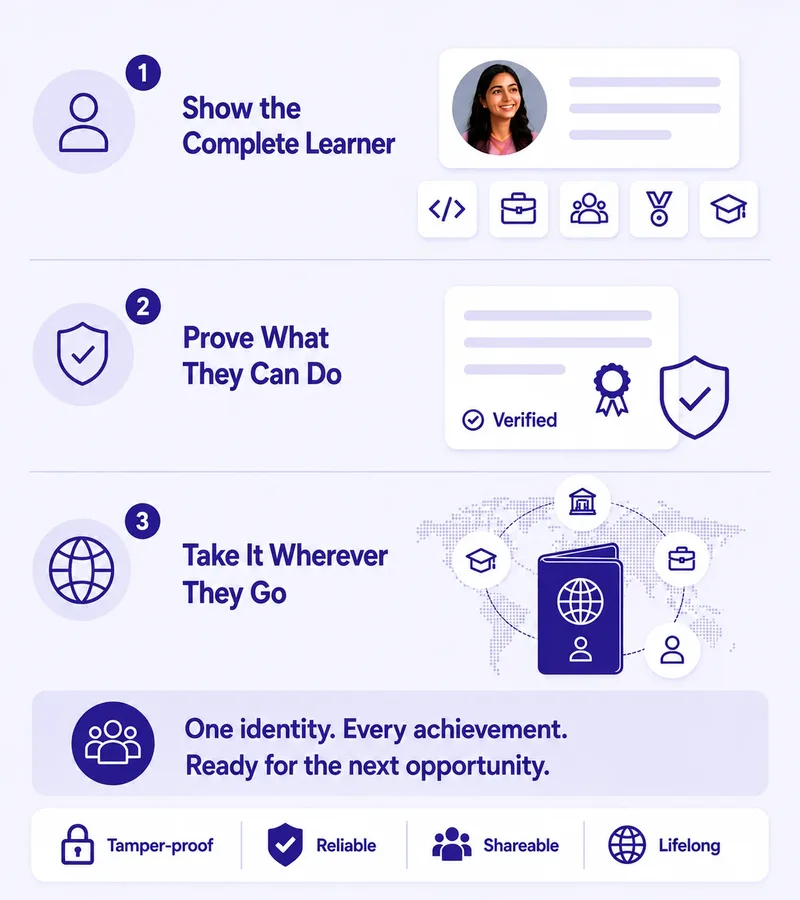
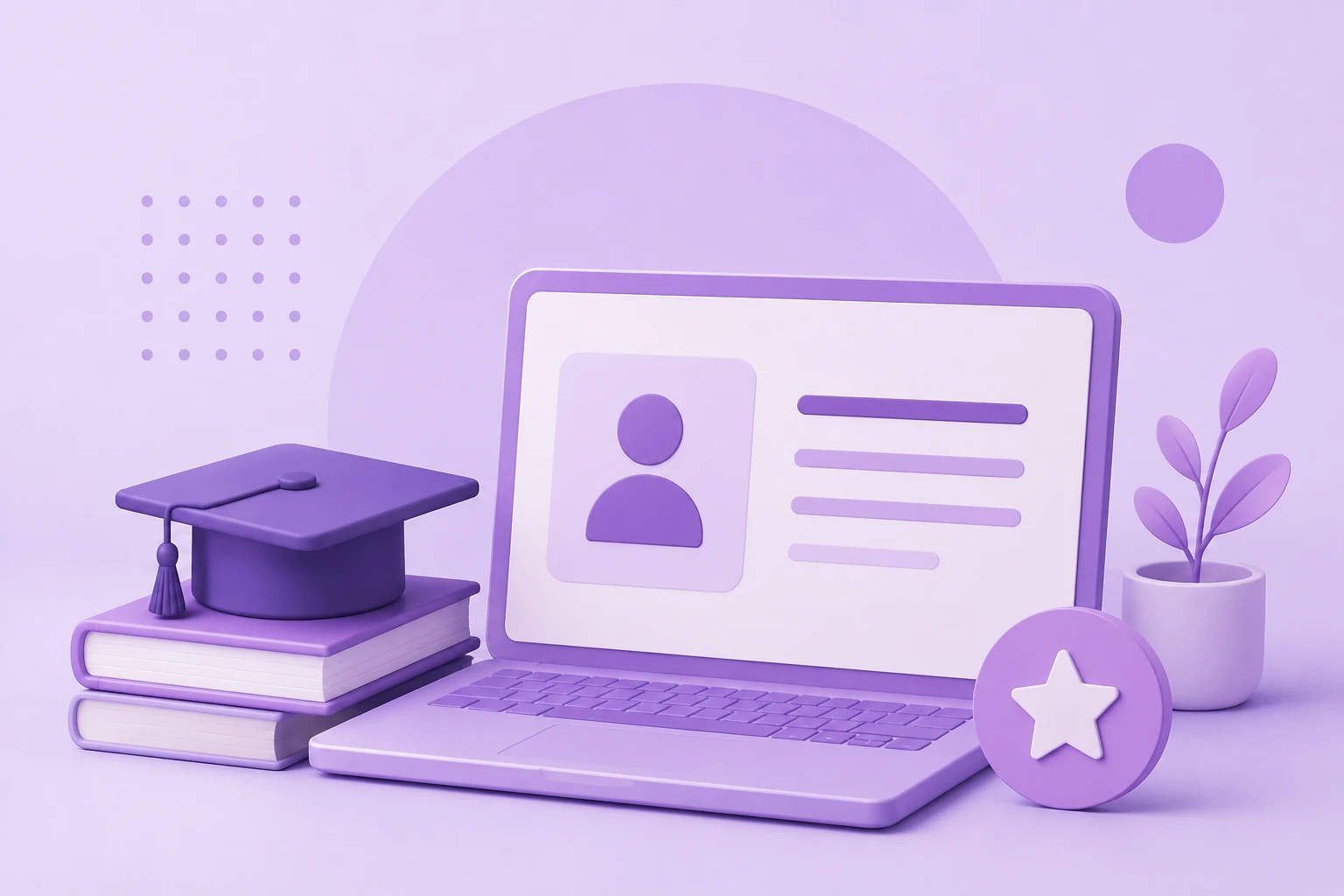
The Skill Passport addresses this gap by creating a structured, verified record of everything that happens beyond the transcript.
It is not a portfolio in the traditional sense — a collection of documents and links. It is a verified learner identity: skills attested by teachers, credentials issued by trusted authorities, achievements timestamped and sealed with cryptographic signatures.
Skills
Documented skills, described in the student’s own words and verified through teacher attestation or credentials. A student who can say “I have Python programming skills — here is the certification, here is the project I built, and here is my teacher’s signed confirmation that I taught these skills to younger students” is making a fundamentally different claim from one who writes “Python skills” on a CV.
Projects
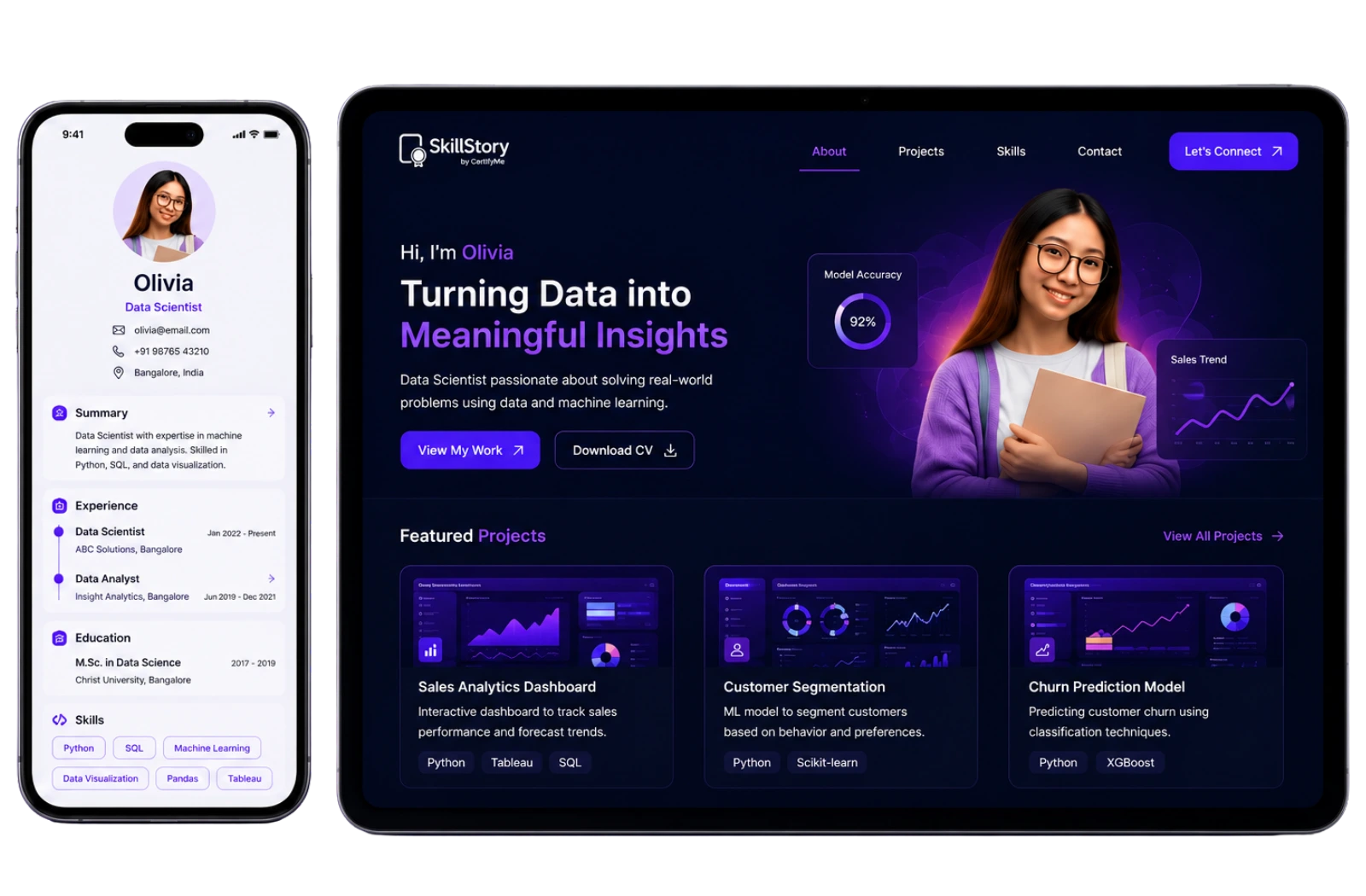
Real work with real outcomes. A portfolio showcase that includes a live app, a research paper with verified publication, or a design project with documented impact is not self-reported — it is evidence.
Credentials
Open Badges and verified credentials issued by trusted providers — whether the school, a certification body, or a third-party platform. Each credential carries a verification link that anyone can follow to confirm it is genuine.
Attestation
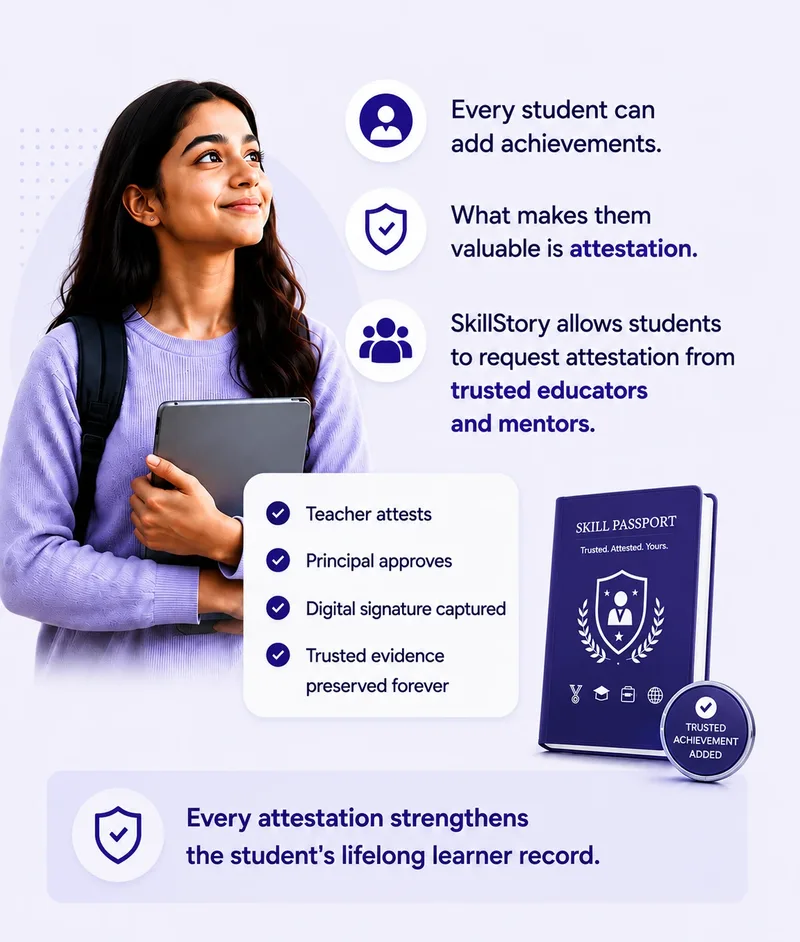
The most powerful signal: a trusted educator’s digital confirmation that an achievement is genuine. Attestation by teachers and mentors transforms a claim into evidence.
A Framework for Understanding the Two Layers
Think of academic achievement and skill evidence as two complementary layers:
Layer 1 — Academic record Grades, transcripts, qualifications. These answer: What did you study, and how well did you perform on assessment?
Layer 2 — Skill Passport Verified skills, projects, experiences, credentials, and attestations. These answer: What can you actually do, and who can confirm it?
Neither layer replaces the other. Together, they give universities, employers, and scholarship committees a genuinely complete picture of the learner.
Students who present only Layer 1 are relying on a single data point. Students who present both give evaluators something far richer — and far harder to dismiss.
What This Means for Students Right Now
The practical implication is not “care less about grades.” It is “do not stop there.”
Every project, internship, certification, award, and experience is worth recording. Every teacher who can attest an achievement should be asked to do so. Every credential earned should be added to the Skill Passport.
The student who arrives at a university application or job interview with a verified record of their complete capabilities — not just their grades — is a fundamentally stronger candidate.
Frequently Asked Questions
Does this mean grades don’t matter? No. Grades remain an important academic signal and are required by most universities and many employers. The Skill Passport is additional evidence, not a replacement.
How is a Skill Passport different from a LinkedIn profile? LinkedIn is self-reported and largely unverified. A SkillStory Skill Passport includes cryptographic verification of credentials and digital attestation from trusted educators — anyone can click a verification link and confirm that an achievement is genuine.
Can a student share their Skill Passport directly in a university application? Yes. The Skill Passport is accessible via a shareable URL. Students can include this link in any application, personal statement, or CV. Recipients can view the complete verified record without creating an account.
What if a student has strong grades but very little else on their Skill Passport? That is completely fine — and honest. Building a Skill Passport takes time. Starting now is better than waiting. Every genuine achievement added makes the record more compelling over time.
Key Takeaways
- Grades measure academic performance — they are necessary but not sufficient
- Applied skills, projects, experiences, and credentials require a separate record
- Three converging trends — skills-based hiring, university holistic admissions, and AI — are increasing the value of verified capability evidence
- The Skill Passport is the structure that captures and verifies what grades cannot
- The two layers — academic record and Skill Passport — work together, not in opposition
Sarah Mitchell is a career education advisor who works with schools and universities on employability frameworks and learner record systems.