
Most students think about their application materials in the year they need them. That is too late.
University applications, scholarship submissions, and internship cover letters are won by students who have spent years building a record — not weeks trying to recall what they did.
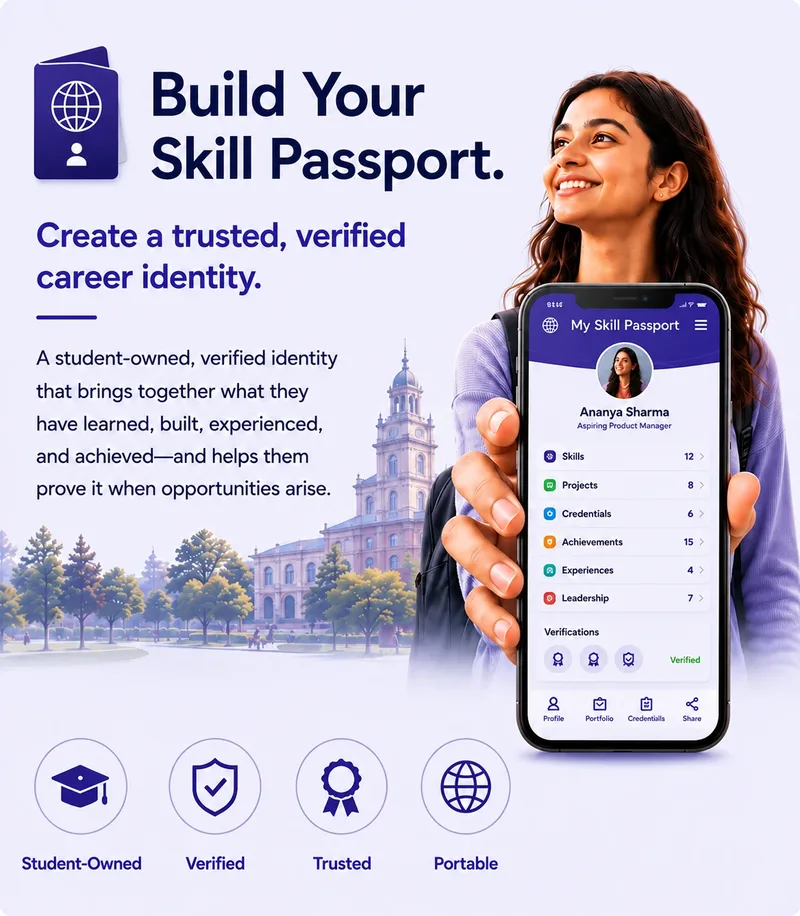
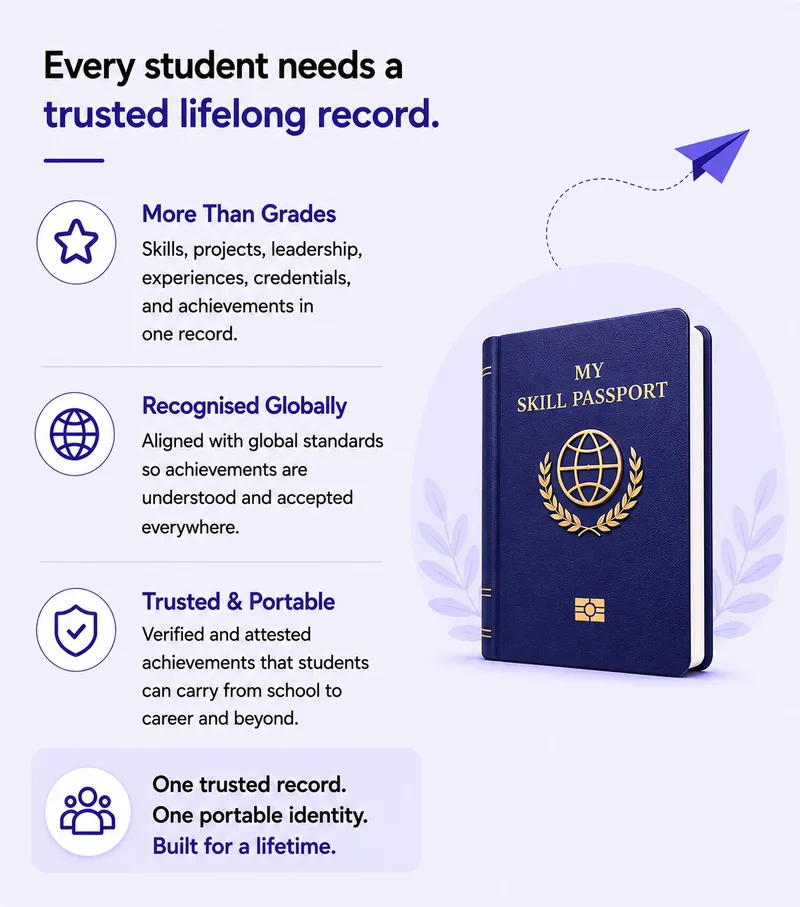
This is the central argument for starting a SkillStory Skill Passport in school: not because it looks good to tick a box, but because a genuine, growing record of skills and achievements is itself valuable — and the earlier it starts, the more valuable it becomes.
The Compounding Record
A Skill Passport builds like interest. Each achievement added creates a richer context for the next one. Each attestation from a teacher builds credibility for future attestations. Each credential earned signals that the student takes learning seriously.
A student who begins at age 12 and adds one meaningful entry per month arrives at their university application with over 60 verified data points in their record. A student who starts at 17 has six.
The difference is not just quantity. It is:
- Depth of evidence — earlier entries show the beginning of a skill journey, not just the end
- Pattern of growth — reviewers can see development over time, not just a snapshot
- Credibility — a record built over years is far harder to fabricate than one assembled quickly
What Students Can Record From Age 10 Onwards
The brief answer: almost everything that matters.
Age 10–12: The Foundation Years
- School projects with real outcomes (science experiments, research papers, creative work)
- Participation in competitions and events
- Extracurricular activities and clubs
- Reading lists and self-directed learning
- First certificates from online platforms or community organisations
These entries are small but significant. They establish that the student takes initiative beyond the classroom.
Age 12–14: Building Skills
- Technical skills that develop (coding, design, music, sport, languages)
- Leadership roles in school clubs or sports teams
- Volunteering and community service
- Competitions with results
- Early certifications in areas of interest (first aid, digital skills, coding)
At this stage, teacher attestation becomes particularly valuable. A teacher who can confirm a student’s leadership in a school science project adds a layer of trust that no self-report can match.
Age 14–16: Deepening Experience
- Internships and work experience
- Advanced certifications
- Project leadership
- Awards and recognition
- Community initiatives the student started or contributed to
This is the period where a Skill Passport starts to tell a coherent story — one of consistent interest, growing capability, and real-world application.
Age 16–18: Career Readiness
- Substantial internship experience
- University-level certifications
- Portfolio projects demonstrating applied skills
- Leadership track record
- Teacher references and attestations across multiple years
By this point, a student who has maintained their Skill Passport consistently has a record that speaks for itself. Not a list of claims — a verified timeline of growth.
Why Teachers and Mentors Are Essential Early
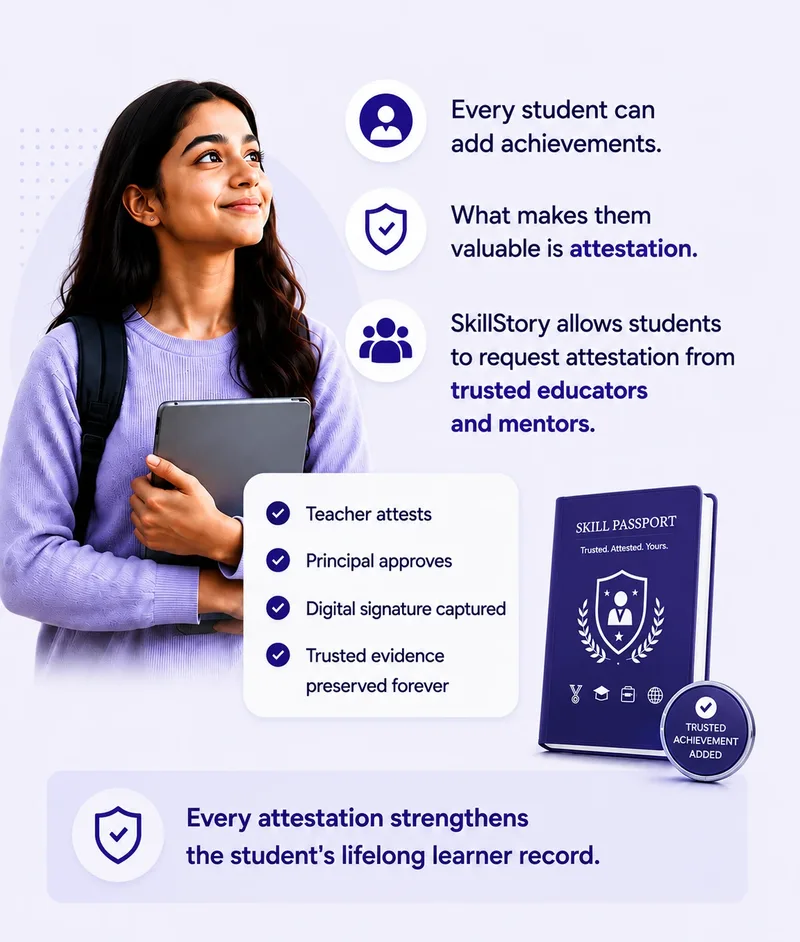
One of the most powerful elements of a Skill Passport is teacher attestation. A teacher who signs an achievement confirmation is putting their professional credibility behind a student’s claim.
The earlier this relationship is established, the more rich and continuous the attestation record becomes. A teacher who has attested three achievements across two years gives a far more credible picture than one who signs a letter in the final term.
Teachers who use SkillStory can attest achievements with a single click — reviewing the evidence the student has submitted and confirming it with a cryptographically sealed digital signature.
What a Rich School-Age Skill Passport Looks Like
Consider two students applying to the same competitive university programme.
Student A submits:
- Predicted grades
- A personal statement with general claims about leadership and interest in technology
- One teacher reference letter
Student B submits:
- Predicted grades
- A SkillStory Skill Passport with:
- 4 verified coding projects with evidence
- 2 competition placements, both teacher-attested
- 3 certifications from recognised providers
- A school robotics club leadership role, attested by the science teacher
- A year of voluntary tutoring, attested by the maths department head
- An internship at a local technology company, with a verified credential from the employer
The grades might be identical. The difference is evidence.
Building the Habit of Reflection
One underappreciated benefit of maintaining a Skill Passport from school age is what it teaches students about themselves.
Students who regularly log achievements, describe what they learned, and request attestation become:
- More articulate about their own capabilities
- More deliberate about what they pursue and why
- Better at communicating their value in interviews and applications
- More aware of gaps in their skill set that they can actively address
These metacognitive habits — knowing what you know and what you can do — are among the most valuable a student can develop.
Frequently Asked Questions
What if a student has very little to put in at the beginning? Start with what exists: a course completed, a project handed in, a club joined. The Skill Passport does not need to be impressive on day one. It needs to be honest and consistent. Reviewers understand that early entries are modest; what they look for is growth.
How often should students update their Skill Passport? Once a month is a good habit — reviewing what was completed, adding new entries, and requesting attestation where appropriate. It takes less than fifteen minutes once the routine is established.
Can students from any school use SkillStory? Yes. Individual students can create a Skill Passport and use it independently. Schools that join SkillStory can enable teachers to attest achievements directly from the school portal, which makes the process faster and more integrated.
Do universities actually look at Skill Passports? The Skill Passport is shareable via a public URL, which students can include in any application. Admissions teams who receive it can view the complete verified record and follow verification links for any individual achievement. Adoption is growing as institutions recognise the value of verified learner records.
Key Takeaways
- The earliest entries in a Skill Passport are as important as the latest ones — they establish the arc of growth
- Students from age 10 onwards have meaningful achievements worth recording and attesting
- Teacher attestation early in school life creates a compounding credibility record
- The habit of reflection that Skill Passport maintenance builds is itself a career-readiness skill
- Starting late is still better than never — but starting early produces the richest result
Dr. James O’Brien specialises in credential frameworks and learner record systems in secondary and post-secondary education.