
For most of the last century, the question “what does this student know?” was answered in one of two ways: a report card, or a transcript.
Both were important. Both remain important. But the world has changed in ways that make those answers incomplete.
Modern learning does not happen only inside the classroom. Students build projects, complete online courses, lead community initiatives, win competitions, participate in internships, earn digital credentials and develop skills that never appear on any formal record.
The question is no longer simply what a student studied. It is what they learned — and what they can demonstrate they are able to do.
That shift is driving the evolution of student records from episodic documents toward something closer to a lifelong learner identity.
Stage 1: The report card
The report card is the oldest and most familiar form of student documentation.
Its purpose is simple: to communicate a student’s performance to parents, usually at the end of a term or school year.
What it captures:
- Subject grades
- Attendance
- Teacher comments
Where it falls short: The report card was designed for a single audience (the parent) at a single moment in time. It communicates performance but provides little context about what the student actually learned or demonstrated. It tells you the grade; it doesn’t tell you the story.
Stage 2: The transcript
The academic transcript is the formal record that accumulates across a student’s school years and travels with them to university or employment.
What it captures:
- Courses completed
- Grades achieved
- Qualifications awarded
- Examination results
Where it falls short: The transcript was designed for a specific institutional audience (the university admissions office) and speaks almost entirely to formal academic outcomes. It does not capture skills, projects, extracurricular achievements, digital credentials, competencies, or co-curricular learning. A student may have spent twelve years demonstrating curiosity, leadership, creativity and collaboration — the transcript will typically show none of it.
Stage 3: Digital credentials and Open Badges
The emergence of digital credentials provided a way to recognise achievements that the transcript misses.
What they capture:
- Individual accomplishments — course completion, skills demonstrated, competitions won, certifications earned
- Issuer information and criteria
- Evidence supporting the achievement
- Verifiable proof of the claim
1EdTech’s Open Badges standard defines a digital credential that contains structured information about a single achievement, including the issuer, the earner, the criteria and optionally evidence. Open Badges 3.0 aligns with the W3C Verifiable Credentials Data Model, which became a W3C Recommendation in May 2025.
Where they fall short: Individual credentials are powerful. But they don’t necessarily connect. A student might accumulate dozens of digital badges from different issuers without ever having a coherent picture of how those achievements relate to each other or to a broader learning journey.
Stage 4: The Comprehensive Learner Record
The Comprehensive Learner Record (CLR) takes the next step: bringing individual achievements into a structured, verifiable record that communicates a broader picture of the learner.
What it captures:
- Academic learning
- Skills and competencies
- Projects
- Credentials and badges
- Internships and work experience
- Leadership and co-curricular achievements
- Evidence and attestation
1EdTech’s CLR Standard 2.0 describes a format for digitally capturing and communicating learning experiences and achievements across academic and workplace contexts. It can bundle multiple achievement credentials and is designed to be learner-controlled and interoperable.
Where it falls short: A CLR is a powerful institutional record. But it is still something that organisations create and issue. The learner receives it rather than continuously building and owning it.
Stage 5: The lifelong learner identity
The next evolution is a learner-controlled record that begins in school and continues through university, career and lifelong learning.
This is not a replacement for any of the previous stages. It is a layer that connects them.
Where a transcript ends at graduation, a lifelong learner identity continues.
Where a credential represents a single moment, a lifelong learner identity represents a journey.
Where a CLR is issued by an institution, a learner identity is owned by the learner — portable across systems, verified by trusted parties, and growing with every meaningful learning experience.
For schools, this raises a practical question: are we building records that end at graduation, or giving students something they can carry forward?
Modern learning happens everywhere
One reason this evolution matters is that learning itself has dispersed.
A student in 2026 may learn through:
| Context | Example |
|---|---|
| Classroom | Physics coursework, mathematics, literature |
| Projects | Robotics, coding, art, research |
| Competitions | Science fairs, hackathons, debate, sports |
| Online learning | Certified courses, MOOCs, programming tutorials |
| Internships | Work placements, industry experience |
| Extracurricular | Clubs, student councils, performances |
| Community | Volunteering, social impact initiatives |
| Credentials | Industry certifications, digital badges |
| Workplace | Part-time work, apprenticeships |
A transcript captures almost none of this.
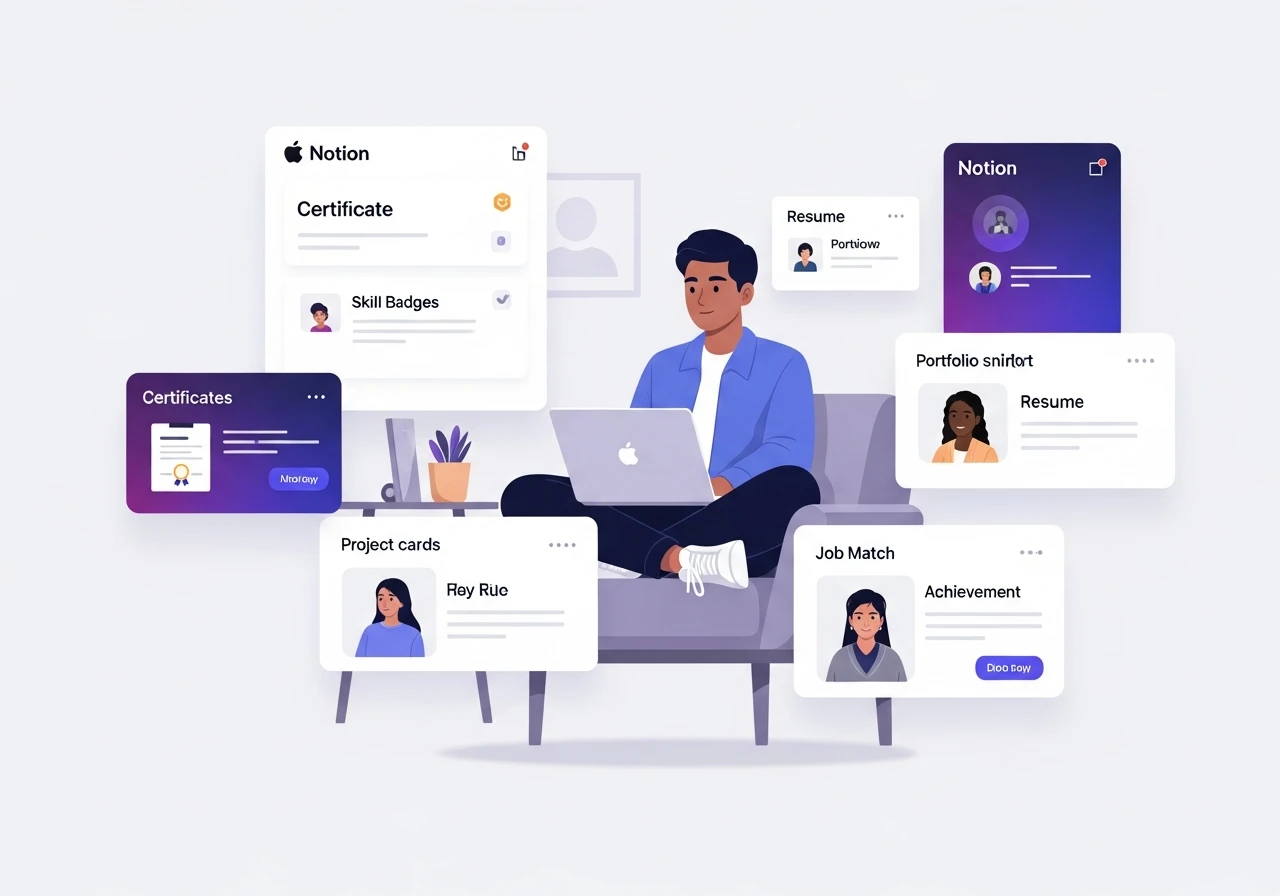
A Skill Passport or comprehensive learner record can create space for all of it.
The argument for a richer record isn’t simply that it looks impressive. It is that these experiences are often where the most durable learning happens — and where skills like problem solving, communication, collaboration and leadership are genuinely developed and demonstrated.
Why learner-controlled records matter
There is an important distinction between a record that an institution holds about a learner and a record that the learner holds about themselves.
Most student records today are held by institutions. The school holds the transcript. The university holds the degree. The credential provider holds the badge.
When the student moves — to a new school, a new country, a new career — they often have to start over. The evidence they accumulated may not transfer. The records may be locked inside a system that no longer serves them.
Learner-controlled records address this problem by giving the learner ownership of their record and the ability to share it independently of the institution that originally created it.
1EdTech’s CLR Standard provides mechanisms for transporting CLR and Open Badge credential data between systems under the learner’s control.
W3C Verifiable Credentials define a model in which the learner acts as the holder — receiving credentials from issuers and presenting them to verifiers independently.
Portable does not mean automatically recognized. Open standards support portability and verification. Whether a particular institution accepts a particular credential is a separate decision made by that institution. That distinction matters when evaluating vendor claims.
What this means for school leaders
The evolution of student records is not an abstract technology debate.
It has practical consequences for how schools design learning recognition, how they support students in transitions, and how they think about the records they create.
A school that issues paper certificates at graduation is building a dead end. A school that connects student achievements to structured, verifiable and portable records is building a foundation.
The shift doesn’t need to happen all at once. Many schools are already partway through this journey — issuing digital credentials, using LMS platforms, maintaining student portfolios. The question is whether those pieces connect into a coherent record that travels with the learner.
10 questions every education leader should ask about the future of student records
- What does our school currently capture beyond grades and examination results?
- How do students take their records with them when they leave?
- Which open standards do our systems support?
- Can our credentials be verified independently of our platform?
- What happens to student records if we change technology vendors?
- How do we recognise skills, projects and co-curricular achievements formally?
- Can a student’s learning record travel from school to university to career?
- How are teacher and mentor contributions to student development documented?
- What is our approach to evidence — not just listing achievements but documenting them?
- Are we building records that end at graduation, or learner identities that continue beyond it?
These are not questions with simple answers. But they are the right questions for an education system that wants to prepare learners — not just for the next examination, but for the next fifty years.
Where SkillStory fits
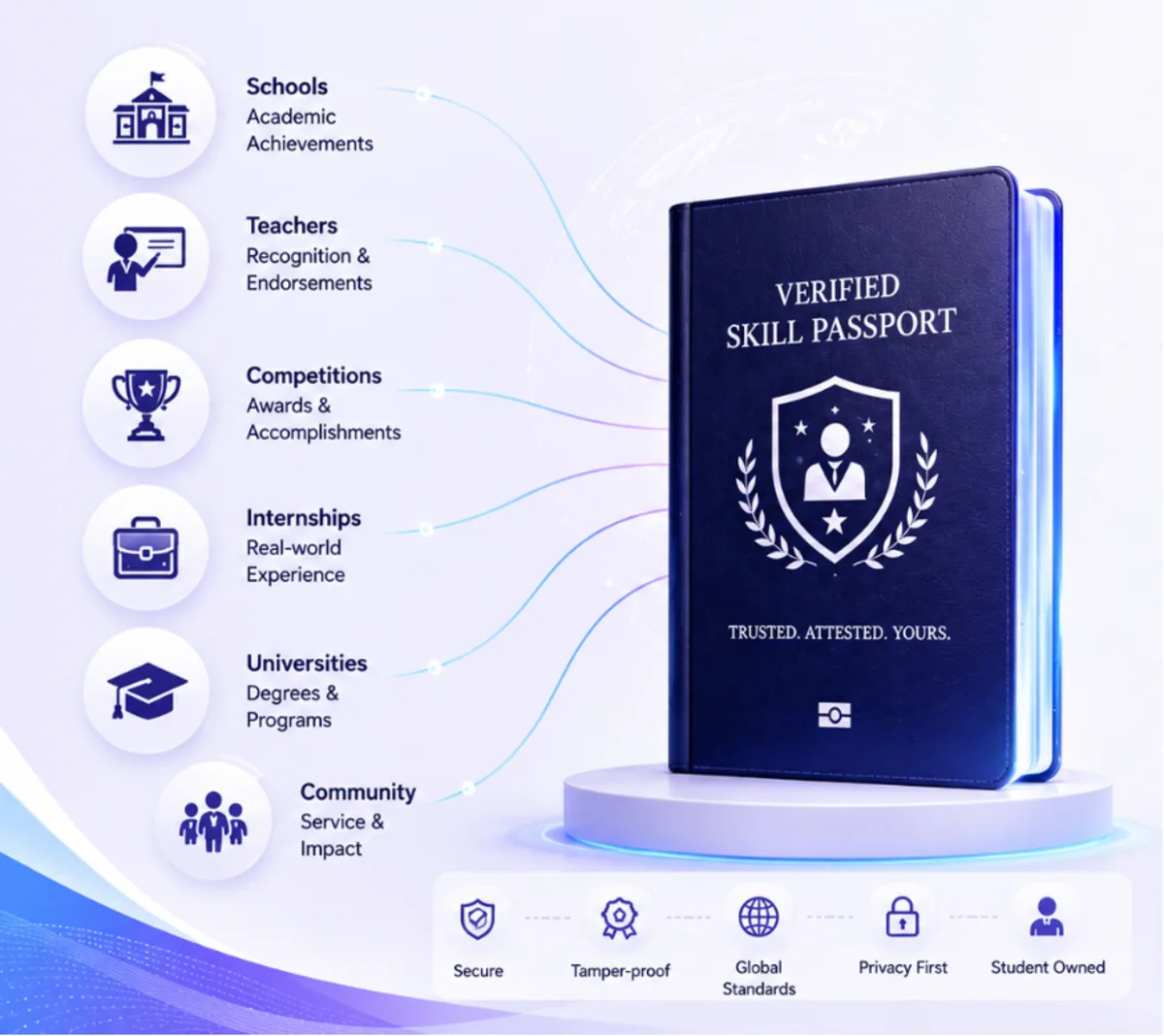
SkillStory’s approach to this challenge is a student-owned Skill Passport — a structured identity that brings together skills, projects, credentials, experiences, achievements and attestations from trusted sources.
The goal is to give students a record that starts in school and continues through every stage of learning and career — not a profile that resets each time they move to a new institution.
For schools, SkillStory’s School License provides the tools to embed this model into existing processes: bulk student onboarding, teacher attestation, a dedicated admin portal and custom school branding.
The report card was the right tool for its time. The lifelong learner record is the right tool for ours.