

A ten-year-old who starts at a school today will graduate in 2034.
By then, the landscape of university admissions, scholarship selection and early employment will look significantly different from today. Skills-based hiring is already reshaping recruitment. Universities are experimenting with holistic admissions processes. Employers are increasingly interested in evidence of capability rather than credential lists.
The record that school builds over the next eight years needs to be ready for that world — not just the world it was designed for.
That requires thinking now about what the school captures, how it captures it, and whether the student can carry it forward.
Why K–12 is the right moment to start
The intuition that learner records matter at university or in employment is correct — but it misses something important.
The evidence that makes a compelling university application or internship pitch is built during the school years. Skills developed at age 12, projects completed at 14, competitions won at 16 — all of these contribute to a record that universities and employers will eventually read.
If those experiences aren’t documented during the school years, the student has to reconstruct them from memory at the moment of application.
A future-ready learner record starts in school — not because it is academically important, but because that is when the evidence is created.
A framework: 14 categories a K–12 learner record should capture
There is no universal standard that dictates exactly what a school must record. But a comprehensive learner record for K–12 should have room for the following:
1. Education
Formal academic courses, subjects, modules, qualifications and results. The foundation of any student record — but only the beginning.
2. Skills
Specific capabilities the student has demonstrated across school life — communication, problem solving, digital literacy, leadership, collaboration and more. Skills should be described using consistent vocabulary; see the school skills taxonomy guide for a practical approach.
3. Projects
Applied work the student has produced — science projects, engineering challenges, coding projects, research papers, business plans, creative works. Projects provide the richest evidence of applied skill.
4. Competitions
Awards, placements and participation in inter-school or national competitions — academic, sport, arts, debate, science, coding, entrepreneurship. Competition results carry weight precisely because they involve external evaluation.
5. Leadership
Student council, club leadership, captaincy, peer mentoring, event organising, team coordination. Leadership experience documented with context is significantly more useful than “leadership skills” stated without it.
6. Sports
Team sports, individual sports, fixtures, tournaments, rankings and achievements. Sport develops discipline, teamwork and resilience in ways that complement academic learning.
7. Arts
Music performance, visual art exhibitions, drama productions, film, creative writing and other artistic achievements. Arts engagement develops creativity, discipline and expressive capability.
8. Community participation
Volunteering, social impact projects, community service, fundraising and other contributions beyond the school gates. Community participation builds perspective, empathy and civic engagement.
9. Certifications
Externally accredited courses and certifications — coding certifications, first aid, music grades, language qualifications, professional development programmes. These carry external recognition independent of the school.
10. Credentials
Digital Open Badges and other structured verifiable credentials issued by the school or external organisations. Credentials carry structured metadata — issuer, criteria, evidence — that a certificate does not.
11. Reflections
The student’s own voice — what they learned, what they found difficult, what they would do differently. Reflections add authenticity and demonstrate metacognitive awareness.
12. Work experience and internships (where applicable)
For older students — workplace visits, job shadowing, internships, part-time work and apprenticeships. Work experience provides evidence of capability in professional contexts.
13. Evidence
Documentation that supports achievement claims — project files, photographs, videos, reports, external assessments. Evidence transforms a listed achievement into a demonstrated one.
14. Teacher and mentor verification
Attestations from educators and mentors who observed the student’s work. A teacher’s signed attestation that a student led a project effectively carries more weight than the student’s own claim.
How the record evolves: age-by-age examples
A learner record is not a fixed document. It grows with the student — reflecting where they are at each stage of their development.
Age 10
At this stage, the record is relatively simple. The goal is to begin documenting early and build the habit.
Education: Year 5 subjects and broad academic engagement.
Projects: Science fair project on water filtration — includes photographs of the experiment and a teacher’s comment.
Skills: Early evidence of curiosity, questioning and collaborative working.
Achievements: Reading programme completion badge.
Activities: School choir, swimming club.
The record at this stage won’t be used for a university application. It builds the foundation — and the habit of documentation.
Age 12
The record begins to show a more defined picture of the learner.
Education: Core subjects with early subject preferences emerging.
Projects: Coding project — built a simple game during an after-school club. Documented with a screen recording and the teacher’s feedback notes.
Skills: Early evidence of programming, problem solving and persistence.
Competitions: Regional junior mathematics challenge — first round participation.
Leadership: Class representative for the student council.
Sports: School football team — regular participation.
Certifications: Scratch coding certification (online).
Age 14
The record is now richer and beginning to support early extracurricular transitions.
Education: Key stage 3 or equivalent outcomes, subject-level performance.
Projects: Group robotics project — built an autonomous line-follower. Documented with team roles, testing notes and a video of the final demonstration. Teacher attestation from the technology teacher.
Skills: Programming, collaboration, project management, mechanical design.
Competitions: Inter-school robotics competition — regional finalist.
Leadership: Technology club co-organiser. Peer tutor in coding for younger students.
Certifications: Python programming course completion (online provider).
Community: Volunteered at a local coding bootcamp for primary school students.
Reflection: “Working on the robotics project taught me that the first design is never the right one. We had to rebuild the chassis twice before we got consistent results.”
Age 16
University preparation begins. The record becomes a tool for scholarship applications and early career conversations.
Education: GCSE, IGCSE, SPM or equivalent examinations. Subject-level grades and predicted results.
Projects: Independent research project on machine learning in healthcare — presented at a school symposium. Includes the research paper, presentation slides and the external judge’s feedback form.
Skills: Research, data analysis, scientific communication, AI literacy, critical thinking.
Competitions: National science fair — shortlisted.
Leadership: Head of the school’s science and technology society. Organised inter-year group workshops.
Work experience: Two-week placement at a technology company — documented with a supervisor’s written reference and a personal reflection.
Certifications: Google Data Analytics certificate. First Aid.
Credentials: Open Badge issued by school for research leadership.
Age 18
The learner record is now a comprehensive picture of twelve years of learning — academic, extracurricular, experiential and personal.
Education: A-level, IB, HSC or equivalent — subjects, grades and qualifications.
Projects: Final-year capstone project — a web application connecting volunteers with local charities. Documented with GitHub repository, user testing notes and teacher supervisor’s attestation.
Skills: Full-stack development, project management, stakeholder communication, UX thinking, leadership.
Competitions: National entrepreneurship challenge — top ten finalist.
Leadership: Deputy head student. Founded the school’s AI literacy programme in Year 12.
Work experience: Summer internship at a tech startup — formal reference letter included.
Certifications: AWS Cloud Practitioner. Duke of Edinburgh Gold.
Community: 200+ hours of volunteering across four initiatives.
Credentials: Multiple Open Badges from school and external providers.
Reflections: Rich, articulate accounts of key moments and what they meant.
Attestations: Four teacher and mentor attestations covering different dimensions of capability.
How this record supports key transitions
University applications Universities increasingly look beyond grades. A structured record with evidence of independent projects, leadership, skills and attestations gives admissions teams more to consider — and gives the student a richer story to tell.
Scholarships Scholarship bodies typically want evidence of achievement, character and potential. A learner record with documented community involvement, teacher attestations and evidence of initiative provides exactly that.
Internships For a first internship or work placement, a student rarely has professional work experience. A learner record that shows applied projects, coding certifications, leadership experience and a supervisor’s attestation from work experience gives them a meaningful starting point.
Career readiness Skills developed at school — when documented with evidence and structured using recognised vocabulary — connect to the language employers use in job descriptions. A learner record built across K–12 gives the student a head start on demonstrating capability.
In all of these cases, one caution applies: a learner record supports the application process. It does not guarantee any particular outcome. The decisions made by universities, scholarship bodies and employers depend on many factors beyond what a student record can control.
Practical principles for building the record
Start early. The record built at 10 is not useful immediately — but the habit of documentation is.
Prioritise evidence over lists. A project with photos, a reflection and a teacher’s note is worth more than twenty activity names with no context.
Make it the student’s record. The student should understand what is in it, why it matters and how to use it.
Embed it in existing processes. The record should grow through what the school already does — not as an additional administrative layer.
Use consistent skills vocabulary. Choose a shared language for describing skills and use it consistently across departments and year groups.
Include teacher voice. Attestations from educators who know the student’s work add a layer of trust that self-reported achievements cannot.
Where SkillStory fits
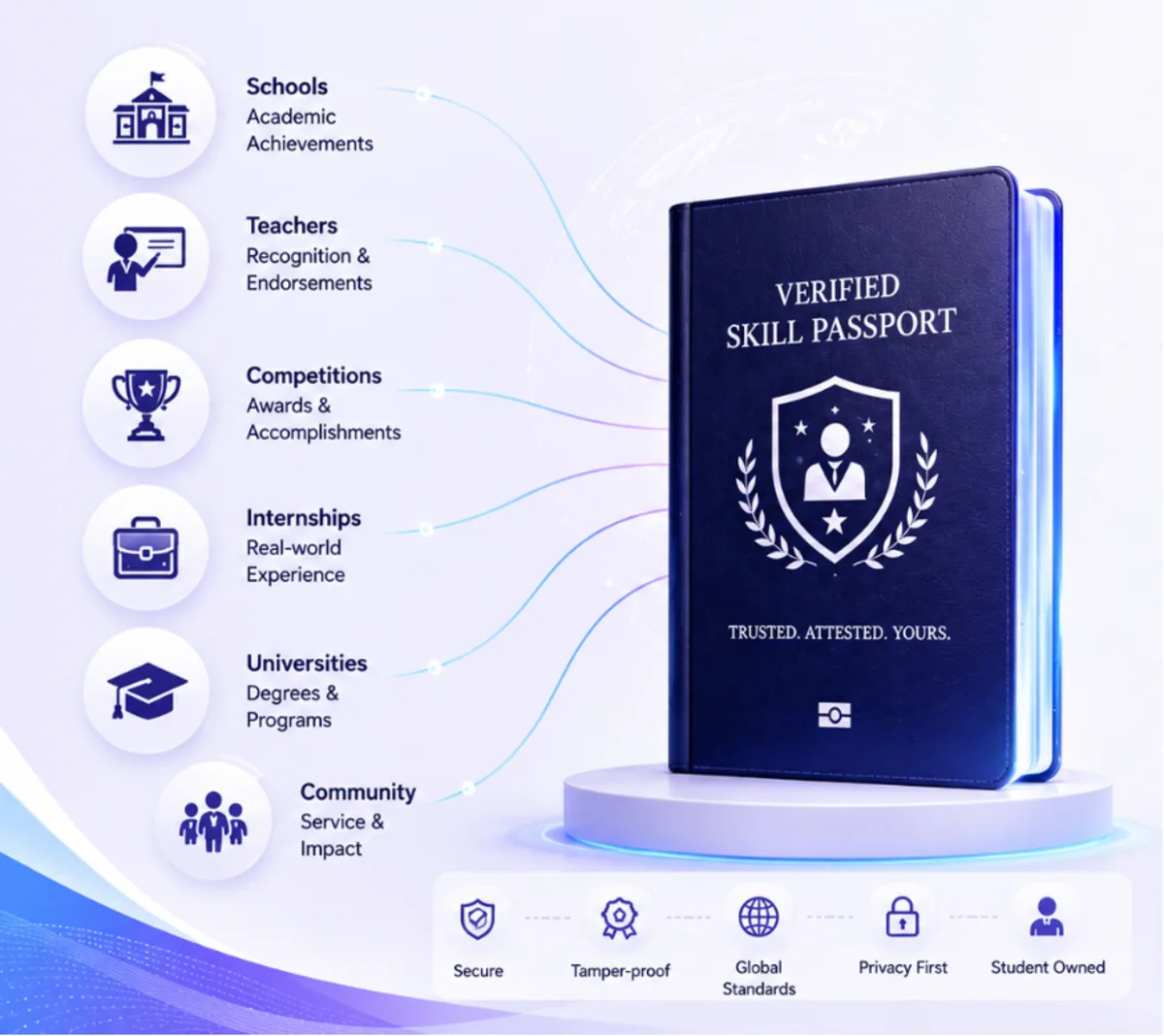
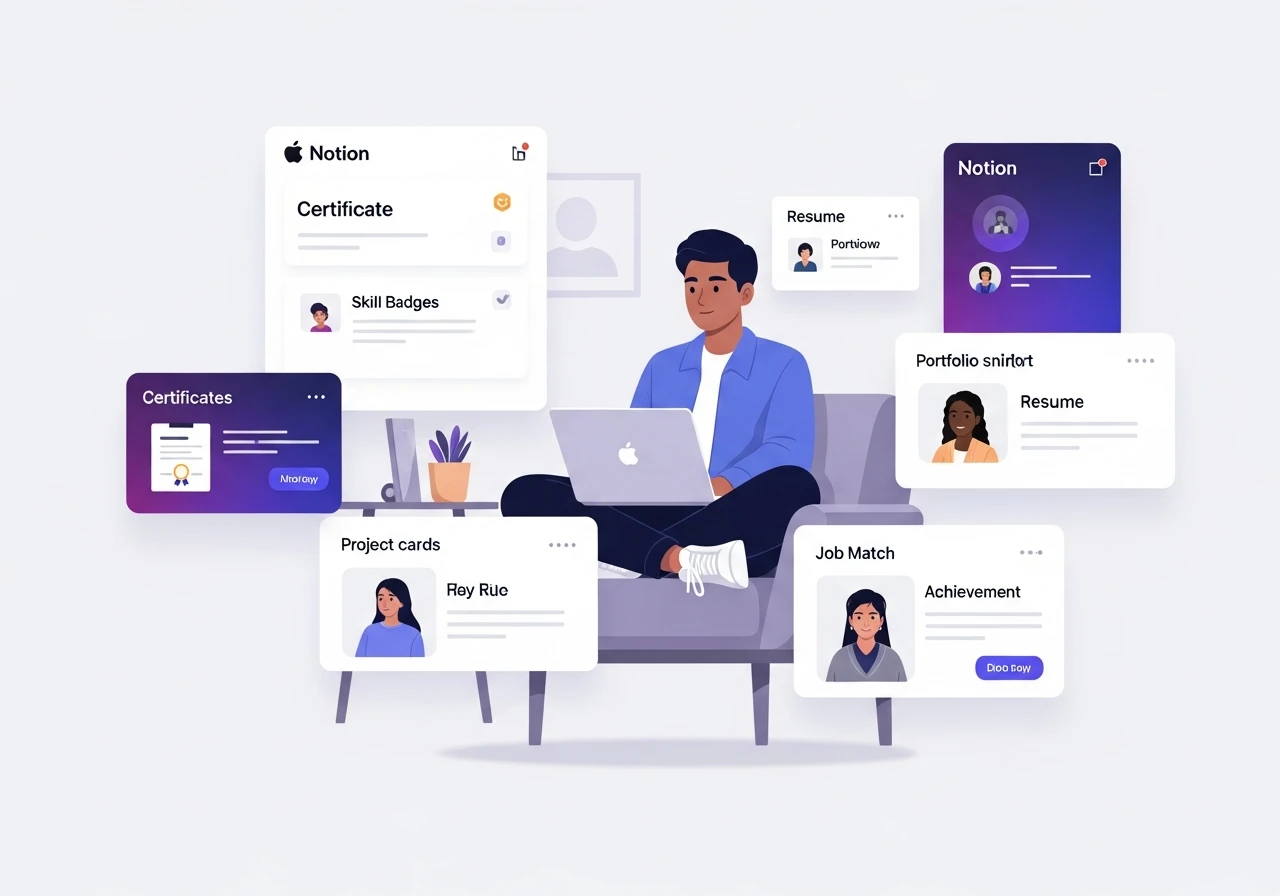
SkillStory’s Skill Passport is designed precisely for this longitudinal model — a student-owned record that starts in school and grows through every stage of learning and career.
For K–12 schools building this approach at scale, SkillStory’s School License provides bulk student onboarding, a teacher attestation workflow, a dedicated admin portal and custom school branding.
The goal is not to replace the transcript.
It is to build something alongside it — a record that captures what grades cannot, carries what certificates don’t, and travels wherever the learner goes.