

Ask ten teachers what “communication” means and you will get ten different answers.
One means written communication. Another means public speaking. A third means interpersonal skills in group settings. A fourth means the ability to explain complex ideas to a non-specialist audience.
All of them are right. None of them are wrong. And none of them necessarily means the same thing.
This is the skills language problem in education — and it has consequences that go far beyond individual teacher interpretation.
When a student records “communication skills” on a portfolio, a scholarship application or a university admission form, no one knows what they mean. When an employer says they want “problem solvers,” no one is sure which school activities would count as evidence.
The gap between how schools describe student capabilities and how universities and employers understand them is a real and growing problem. Skills taxonomies are the bridge.
What is a skills taxonomy?
A skills taxonomy is a structured, organised vocabulary for describing skills and competencies.
Rather than allowing every person, school and institution to use different words for the same capability, a taxonomy defines:
- What the skill is — a clear description of the capability
- How it relates to other skills — broader categories and sub-skills
- What evidence or context supports it — in some frameworks, links to occupations, learning outcomes or qualifications
A taxonomy is not a list of activities. It is a common language — one that allows a school in one city, a university in another country and an employer in a third to understand a student’s achievement in roughly the same way.
Why schools struggle to describe skills consistently
Schools are deeply good at describing academic outcomes. The language of grades, marks and qualifications is well established. A grade 7 in mathematics means approximately the same thing in any UK secondary school. An A in Advanced Placement Chemistry is understood by US universities.
But skills — especially those developed through projects, extracurricular activities, leadership roles and experiential learning — have no equivalent standardised language.
This creates several problems:
The vocabulary problem. The same capability is described in many ways. “Leadership” might appear as “led a team,” “served as captain,” “managed the project,” “acted as team coordinator” — all referring to overlapping but distinct things.
The specificity problem. “Communication” describes almost everything a human being does. Without further structure, it communicates almost nothing. A student who can deliver a ten-minute technical presentation to a panel of judges and a student who can write clearly are both “good communicators” — but in ways that are genuinely different.
The comparability problem. A student who says “I have strong problem-solving skills” and a student who says “I can analyse complex systems and propose solutions” may be describing the same capability or very different ones. Without a shared framework, no one can tell.
The recognition problem. If a school records an achievement using one vocabulary and a university reads it using another, important context gets lost in translation.
The same skill, described differently by different stakeholders
Consider a skill like Collaboration.
| Stakeholder | How they describe it |
|---|---|
| Student | “I work well in teams” |
| Teacher | “Demonstrates effective group participation and peer support” |
| School record | “Co-curricular: team project participant” |
| University | “Teamwork and interpersonal effectiveness” |
| Employer | “Cross-functional collaboration and stakeholder communication” |
| Credential provider | “Collaborative problem-solving (Level 2)” |
These descriptions may all be referring to the same underlying capability. Or they may not. The lack of a shared vocabulary makes it nearly impossible to tell.
This is not a trivial problem. When universities and employers evaluate students, they are making decisions under genuine uncertainty — partially because the records they receive don’t allow for meaningful comparison.
Why skills like these matter
Let’s consider six skills that appear consistently in educational contexts:
Communication — expressing ideas clearly in writing, speaking and visual forms, for different audiences and purposes.
Leadership — guiding a group toward a shared goal, making decisions under uncertainty, motivating others.
Problem Solving — identifying challenges, analysing their causes, generating and testing solutions.
Data Analysis — collecting, interpreting and drawing meaningful conclusions from information.
Collaboration — working effectively with others, sharing responsibility, navigating disagreement.
Digital Literacy — using digital tools purposefully, understanding their limitations and applying them in relevant contexts.
Each of these represents a genuine and valuable capability. Each also covers a wide range of sub-skills and contexts. A structured taxonomy helps distinguish between them and describe them precisely enough to be useful.
Major skills frameworks and taxonomies
Several frameworks have been developed to bring structure to skills description in education and employment contexts.
ESCO
ESCO (European Skills, Competences, Qualifications and Occupations) is the European Commission’s multilingual classification of skills, competences and occupations. It contains thousands of structured skill concepts, each with a description, related skills and links to occupations.
ESCO is particularly useful because it connects skills to occupations — which means a school achievement described in ESCO terms can be understood in the context of career pathways. A student who demonstrates “Python programming” or “data visualisation” can see how those skills connect to occupations like data analyst or software developer.
ESCO is not universally used and is most relevant in European contexts. But its approach — structured, described and linked to both other skills and to occupational categories — illustrates what a useful taxonomy looks like.
O*NET
The Occupational Information Network (O*NET) is a US Department of Labor resource that describes the skills, knowledge, abilities and activities associated with occupations. It is widely used in workforce development and career guidance contexts in the United States.
IMS Global / 1EdTech skill alignment
1EdTech’s Open Badges specification supports alignment to external skills frameworks. A badge can include a reference to a specific skill definition from a recognised taxonomy — creating a direct link between a learning achievement and a structured skill definition.
This means a school that issues an Open Badge for a robotics project can align that badge to relevant ESCO skills, making the achievement more legible to any organisation that uses ESCO as a reference point.
How skills taxonomies connect learning to careers
The value of a skills taxonomy becomes clearest when you trace the journey from learning to opportunity:
Learning → Achievement → Skill → Credential → Occupation → Opportunity
A student who builds an AI chatbot (learning) demonstrates problem solving, programming and collaboration (skills). Those skills can be documented as part of a verified credential or Skill Passport. The credential can reference relevant ESCO or O*NET skill definitions (taxonomy alignment). That alignment makes the achievement legible to universities and employers who use those frameworks.
This doesn’t mean the project automatically qualifies the student for a job. It means the achievement can be described precisely enough that a relevant organisation can understand and evaluate it.
Why taxonomy alignment makes learner records more useful
Without taxonomy alignment, a learner record is a collection of self-described achievements. With alignment, it is a structured record of capabilities that can be understood across systems.
For universities: taxonomy-aligned skills give admissions teams a clearer picture of what a student can do, beyond grades and predicted results.
For employers: skills described using recognised frameworks are easier to map to job requirements — which increasingly use structured skills language in job descriptions and applicant-tracking systems.
For the learner: seeing their achievements described in terms of recognised skills helps them understand their own strengths and how those strengths connect to future opportunities.
How schools can start building a school-wide skills vocabulary
Building a shared skills vocabulary doesn’t require adopting a full external taxonomy on day one. Schools can start smaller:
Step 1: Audit how skills are currently described. Collect the language used in student reports, project assessments and co-curricular records. Look for inconsistency and ambiguity.
Step 2: Define a core skills vocabulary. Choose ten to fifteen key skills the school wants to recognise and describe each clearly. Use existing frameworks (ESCO, O*NET) as a reference, not as a constraint.
Step 3: Align learning activities to skills. Map the school’s existing projects, activities and programmes to the skills vocabulary. Which activities provide evidence of which skills?
Step 4: Build evidence into recognition. Don’t just record that a student “demonstrated leadership.” Record what they did, how, and with what outcome — and align that to the skill definition.
Step 5: Connect to credentials. Use the skills vocabulary when issuing digital credentials or Open Badges. Where possible, align badges to recognised skill frameworks.
Step 6: Review and refine. A skills vocabulary should evolve as the school’s curriculum and the wider labour market evolve.
Where SkillStory fits
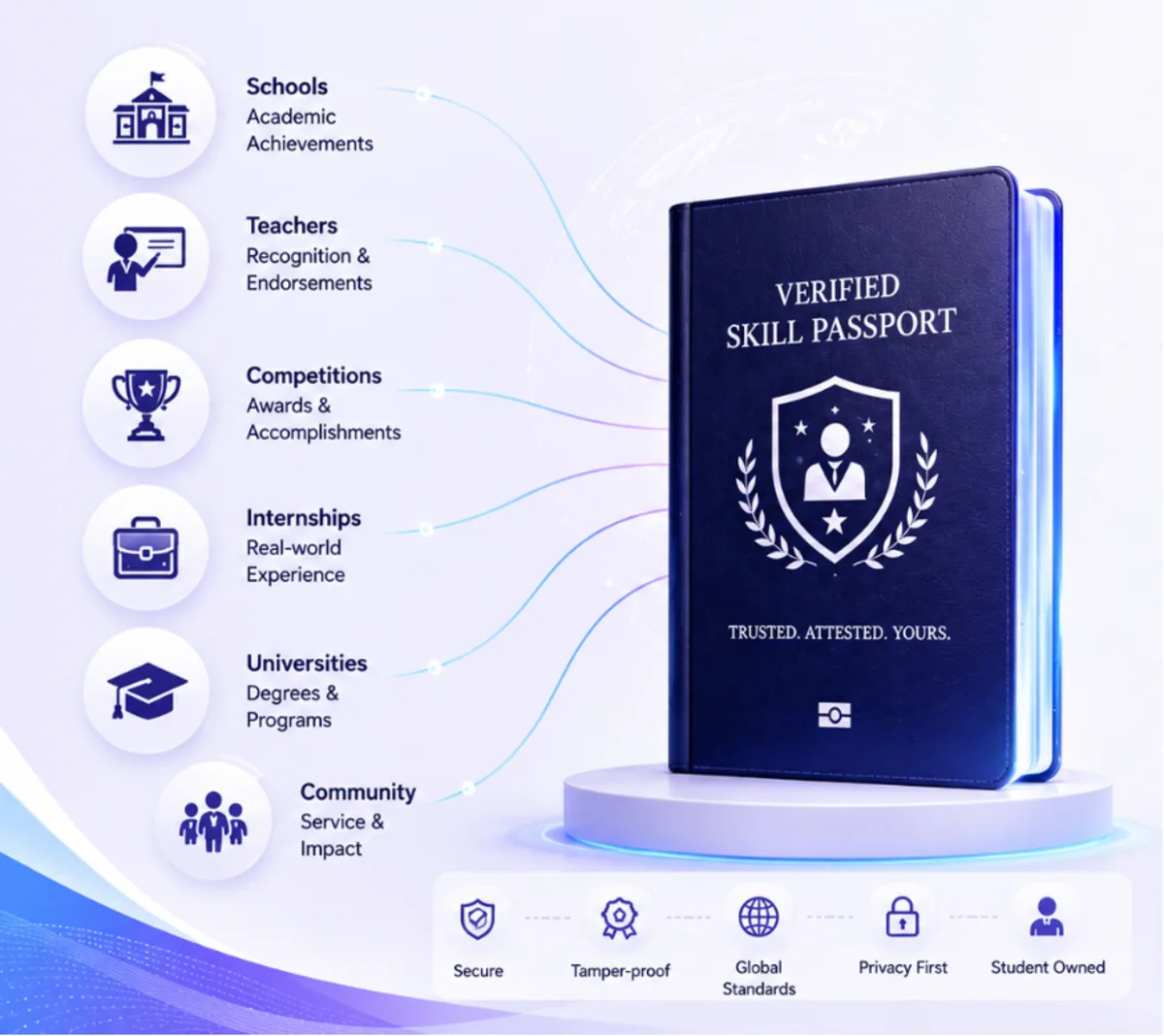
SkillStory’s Skill Passport is built around skills as a core concept. Students can document their skills alongside the projects, credentials and experiences that provide evidence for them — creating a record that connects what they did to what they can demonstrate.
For schools building a structured approach to skills recognition, SkillStory’s School License provides the tools to embed teacher attestation and skills-aligned credentialing into existing school processes.
A shared skills vocabulary won’t emerge overnight. But every school that defines its terms more precisely, documents its students’ capabilities more rigorously and connects those capabilities to recognised frameworks is contributing to a record that will serve those students for decades.
The goal isn’t a perfect taxonomy. It is a common enough language that a student’s achievements can be understood — by the school that created them, the university that receives them and the employer who eventually hires them.