
A student spends twelve or thirteen years building a record at school.
They complete courses, earn results, win competitions, join clubs, lead initiatives, participate in internships, complete certifications and develop skills across every part of their school life.
When they graduate, they may take a transcript and a folder of certificates.
And then they start again.
A new university profile. A new application form. A new LinkedIn page. A new portfolio built from whatever evidence they happened to keep.
The record their school built — in multiple systems, across multiple years — largely stays behind.
This is the portability problem. And for international schools, CBSE and ICSE institutions, private school groups, education trusts and government education departments, it is a growing governance concern.
Where students go after school
A student who leaves a school in India, the UK, Singapore or the UAE may go on to:
School → University → Another country → Scholarship → Internship → Employer
Each of those transitions involves presenting their record to a new organisation.
Each organisation asks variations of the same questions:
- What did you study?
- What did you achieve?
- Can you prove it?
Today, those questions are answered with transcripts, recommendation letters and self-reported achievements. For students who studied abroad, changed institutions or pursued non-traditional learning paths, the answers become harder to assemble.
A portable learner record addresses this by ensuring that the student’s record is expressed in a form that can travel with them — regardless of which system it originated from and regardless of which system the receiving organisation uses.
Why achievements get trapped
Student data is usually fragmented across institutional systems:
- Academic results in the SIS
- Co-curricular records in a spreadsheet
- Project work in an LMS
- Certificates as PDFs
- Competition results in an email folder
- Teacher recognition in informal notes
Each of these systems was designed for one purpose within one institution. None of them was designed to travel.
When a student leaves, the institution keeps the data. The student keeps what they can manually retrieve — which is rarely everything.
What makes a credential portable?
A credential is portable when the learner can carry it and present it independently of the system or institution that created it.
This requires:
- An exportable format — the credential must exist in a form the learner can hold and share
- Verifiable proof — the recipient must be able to confirm the credential is authentic without contacting the original issuer
- Structured information — the credential must convey enough context (issuer, criteria, achievement, evidence) for a third party to understand it
Open standards address all three requirements.
1EdTech’s Open Badges 3.0 defines digital credentials that carry structured achievement metadata — including the issuer, criteria, evidence and the earner’s identity — in a format that aligns with W3C Verifiable Credentials.
W3C’s Verifiable Credentials Data Model 2.0 became a W3C Recommendation in May 2025 and defines a model for credentials that can be cryptographically secured, independently verifiable and presented by the learner without returning to the original issuer.
1EdTech’s CLR Standard 2.0 provides a way to bundle multiple Open Badge credentials into a broader Comprehensive Learner Record — creating a structured picture of the learner’s full record rather than isolated individual achievements.
Portable, interoperable, verifiable and recognised: an important distinction
These words are frequently used as though they mean the same thing. They do not.
| Term | What it means |
|---|---|
| Portable | The learner can carry and present the record outside its original system |
| Interoperable | Different systems can exchange and interpret the data using compatible standards |
| Verifiable | A recipient can cryptographically confirm the credential’s authenticity |
| Recognised | A specific institution has decided to accept the credential for a specific purpose |
| Accepted | The receiving organisation has acted on the credential for a particular decision |
Open standards support portability, interoperability and verifiability. They do not guarantee recognition or acceptance.
Whether a university accepts a digital badge for admissions, or an employer accepts a CLR as evidence of experience, is a decision made by that organisation. It cannot be guaranteed by any standard or any technology platform.
This matters for schools because some vendors make claims that overstate what open standards deliver. A more accurate statement is:
Open standards increase the possibility that credentials will be understood, verified and considered by receiving systems — they do not guarantee that every institution will act on them.
The role of evidence
One reason digital credentials built on open standards are more useful than paper certificates is the ability to include evidence.
A paper certificate states that a student completed something. An Open Badge can include:
- The specific criteria for the achievement
- A link to the student’s project, portfolio or work product
- Teacher or mentor attestation
- Alignment to skills frameworks
That evidence gives receiving organisations more context for evaluating the achievement — and gives the student a more compelling way to present what they have done.
A credential without evidence asks the recipient to trust the claim. A credential with evidence gives them a way to assess it.
How open standards increase cross-system portability
The practical mechanism of portability under open standards works like this:
- A school issues an Open Badge or CLR using an open-standards-compliant platform
- The credential is cryptographically signed by the issuing institution
- The learner receives the credential and holds it in a wallet or portable record
- The learner presents the credential to a university, scholarship body or employer
- The recipient verifies the credential using the open standard — without contacting the school directly
This is meaningfully different from a system in which the recipient must log into a vendor’s platform to check a credential. It removes the dependency on any single vendor’s continued operation.
It also means a credential issued by a school in India can, in principle, be verified by a university in the UK or Canada — as long as both systems support the same open standard.
What an institutional portability strategy looks like
For a school group, education trust or government education department building a portability strategy, the key decisions are:
1. Which standards will you support? At minimum: Open Badges 3.0 and W3C Verifiable Credentials. For a broader learner record: CLR 2.0.
2. What will you credential? Academic achievements, co-curricular recognition, skill-aligned credentials, teacher attestations, project evidence.
3. Who owns the record? The learner should be able to take their record with them when they leave the institution.
4. How will you handle vendor transition? Standards-based platforms should allow data export in a format that another compliant system can ingest.
5. How will you educate students and parents? A portable credential is only useful if the learner knows how to use it.
Institutional checklist: building a portable credentialing strategy
Before implementing or procuring a credentialing platform, education institutions should confirm:
- The platform issues credentials in CLR 2.0 and/or Open Badges 3.0 format
- Credentials align with W3C Verifiable Credentials Data Model 2.0
- Learners can export and hold their own credentials independently of the platform
- Credentials can be verified by a third party without the recipient accessing the vendor’s system
- Credentials can include evidence, criteria and issuer information
- The platform can integrate with the school’s existing SIS and LMS
- Student data can be exported if the institution changes vendors
- The learner retains access to their record after leaving the school
- The school understands the distinction between portability and institutional recognition
- Staff are trained on how to issue, verify and explain credentials to students and parents
Where SkillStory fits
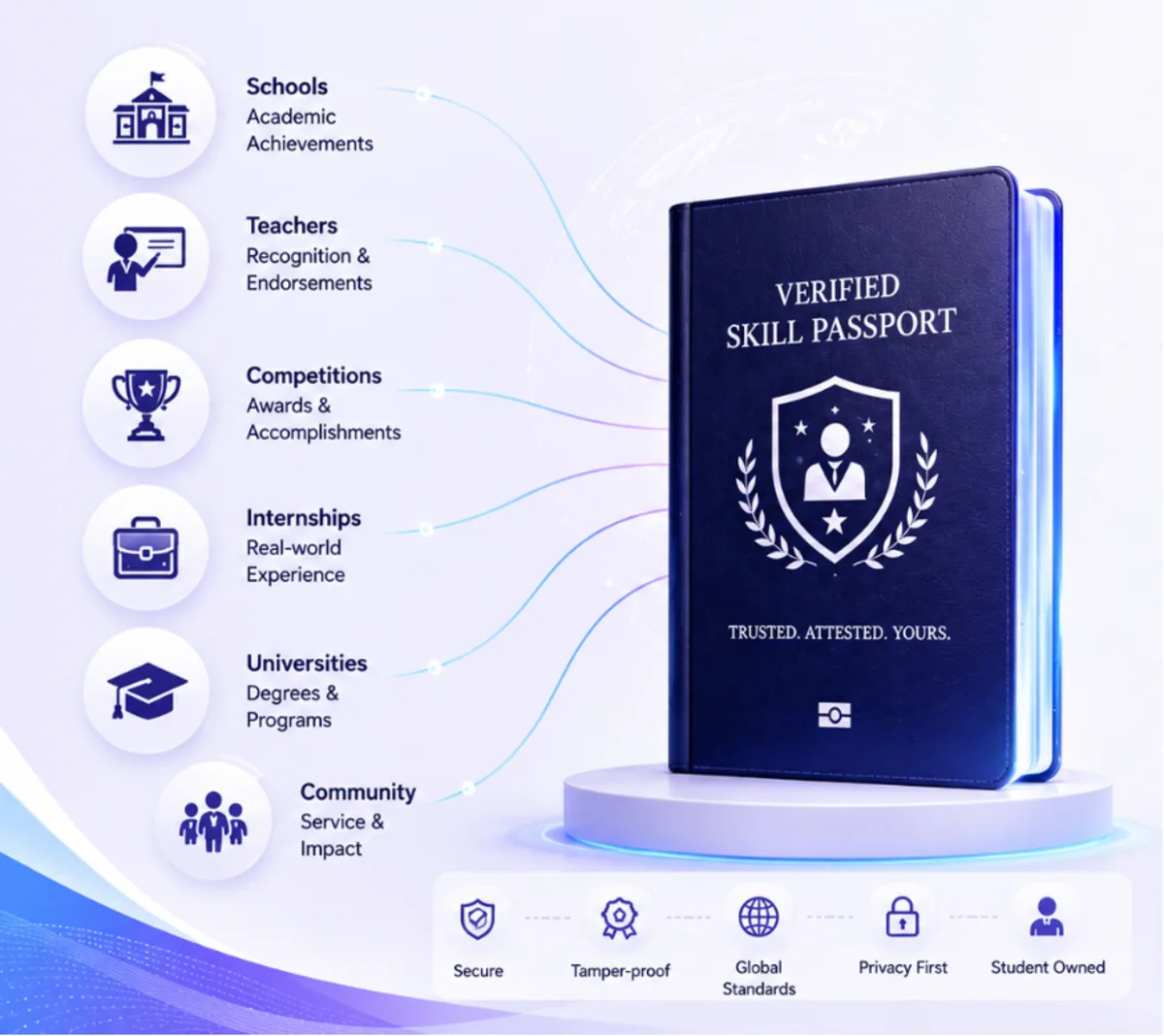
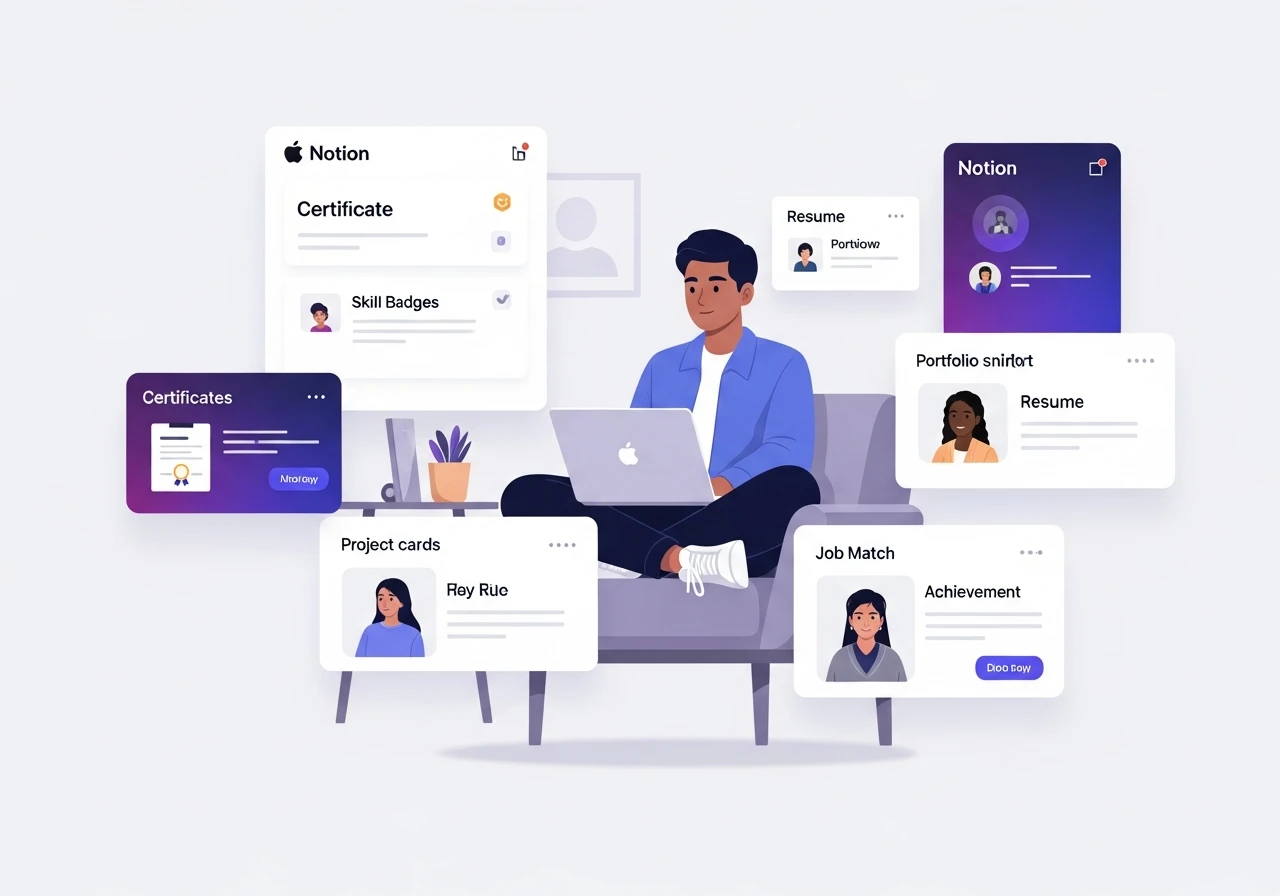
SkillStory approaches portable credentialing through a student-owned Skill Passport — a structured learner record that brings together skills, projects, credentials, experiences and verified achievements.
The Skill Passport is designed to travel with the learner from school through university and career, rather than remaining locked inside a single institutional system.
For schools and school groups building this at scale, SkillStory’s School License provides the infrastructure: admin portal, bulk onboarding, teacher attestation tools and custom institutional branding.
A student’s school years are twelve or thirteen years of meaningful learning. The records built during those years should last at least as long — and travel wherever the learner goes.