
Imagine a student who has spent three years at a school.
They have completed courses, won competitions, led a club, built projects and earned several certifications.
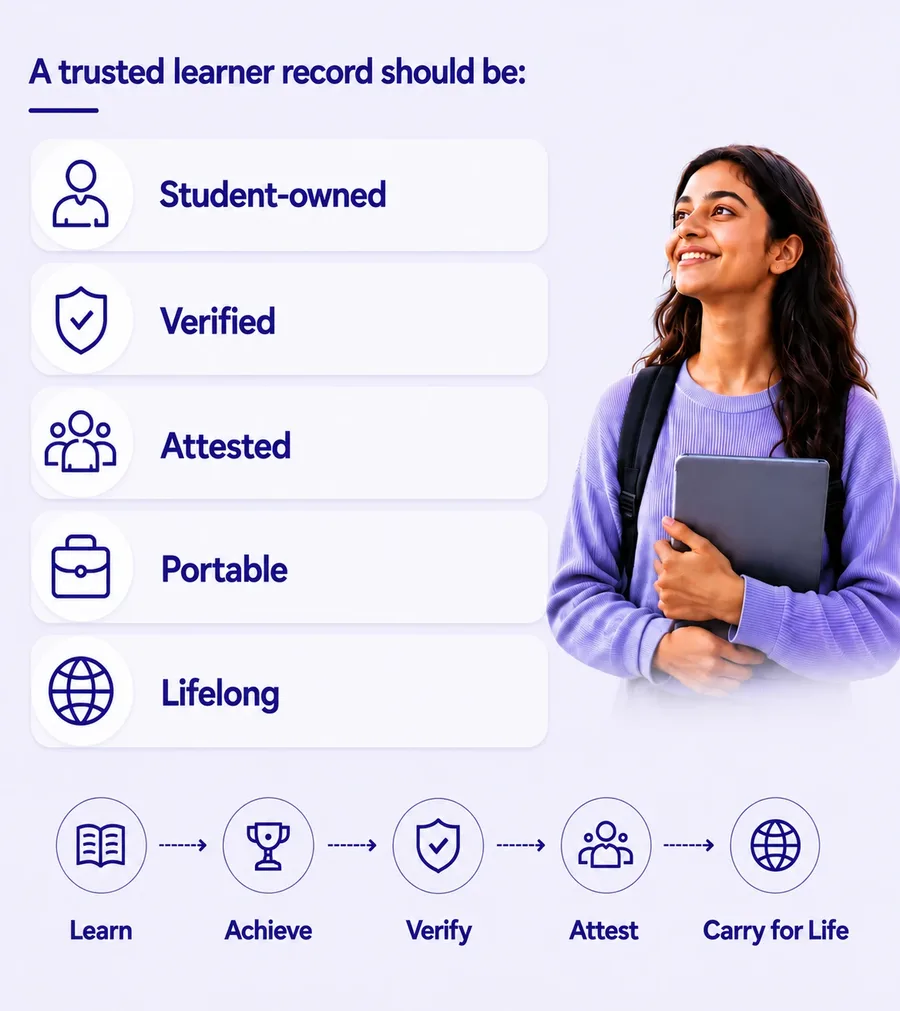
Now imagine you need to describe all of that in a single, structured digital record — one that can be independently verified, carried by the student, and understood by a university or employer anywhere in the world.
That is the problem this ecosystem of standards was designed to solve.
Three specifications work together to make it possible:
- Open Badges 3.0 — for individual achievements
- W3C Verifiable Credentials — for the underlying trust model
- 1EdTech CLR 2.0 — for bringing achievements together into a broader record
Understanding how these pieces fit requires starting with a simple analogy.
A simple analogy: the credential wallet
Think of a traditional leather wallet.
Inside, you carry different cards for different purposes: a driving licence, a bank card, a student ID, a loyalty card, a library card.
Each card represents a specific claim about you — issued by a different organisation, for a different purpose, used in different contexts.
The wallet itself is neutral. It holds the cards. You control what you share and with whom.
Now translate this to digital credentials:
- Each card is an Open Badge — a verifiable digital credential representing a specific achievement
- The security features on each card (holograms, chips, signatures) are Verifiable Credentials — the cryptographic layer that makes the claim trustworthy
- The wallet as a complete picture of who you are is the CLR — a structured record that bundles achievements together
Open Badges 3.0: individual achievement credentials
An Open Badge is a digital credential that represents a specific, discrete achievement.
1EdTech defines Open Badges as a way of packaging information about a single recognition or achievement, including the issuer, the criteria for earning it, and optionally evidence of the achievement.
What an Open Badge contains:
- Achievement — what was accomplished (winning a competition, completing a course, demonstrating a skill)
- Issuer — who issued the badge (the school, the training provider, the competition organiser)
- Criteria — what the earner had to do to receive it
- Evidence — optional supporting documentation (a project link, a portfolio, a teacher’s assessment)
- Earner — who received the badge
- Date — when it was issued
Open Badges 3.0 is the latest version of the standard. It aligns with the W3C Verifiable Credentials Data Model 2.0, which means an Open Badge issued under this version can be cryptographically signed and independently verified.
What an Open Badge does not do on its own: A single badge represents a single achievement. It doesn’t communicate the relationship between achievements, the broader learning journey, or the full picture of the learner.
W3C Verifiable Credentials: the trust layer
The W3C Verifiable Credentials Data Model provides the underlying model that makes a digital credential trustworthy and independently verifiable.
It became a W3C Recommendation in May 2025, meaning it has reached the highest level of technical standardisation from the World Wide Web Consortium.
The three roles in the VC model:
| Role | Who they are | What they do |
|---|---|---|
| Issuer | School, university, course provider | Creates and digitally signs the credential |
| Holder | The learner | Receives and controls the credential |
| Verifier | University, employer, scholarship body | Confirms the credential’s authenticity |
Why this matters: In the traditional model, a recipient who wants to verify a certificate must contact the issuing organisation — which takes time and may not be possible years later.
In the Verifiable Credentials model, the credential is cryptographically signed by the issuer at the moment of issue. A verifier can confirm its authenticity using the signature — without contacting the issuer directly.
What Verifiable Credentials do not do: They establish that a credential is authentic. They do not determine whether a recipient organisation will accept it or act on it. Verification and recognition are different things.
CLR 2.0: the broader learner record
A Comprehensive Learner Record — defined by 1EdTech’s CLR Standard 2.0 — goes beyond individual credentials.
Where an Open Badge represents one achievement, a CLR can bundle multiple achievement credentials — including Open Badges — into a broader, structured picture of the learner.
What a CLR captures:
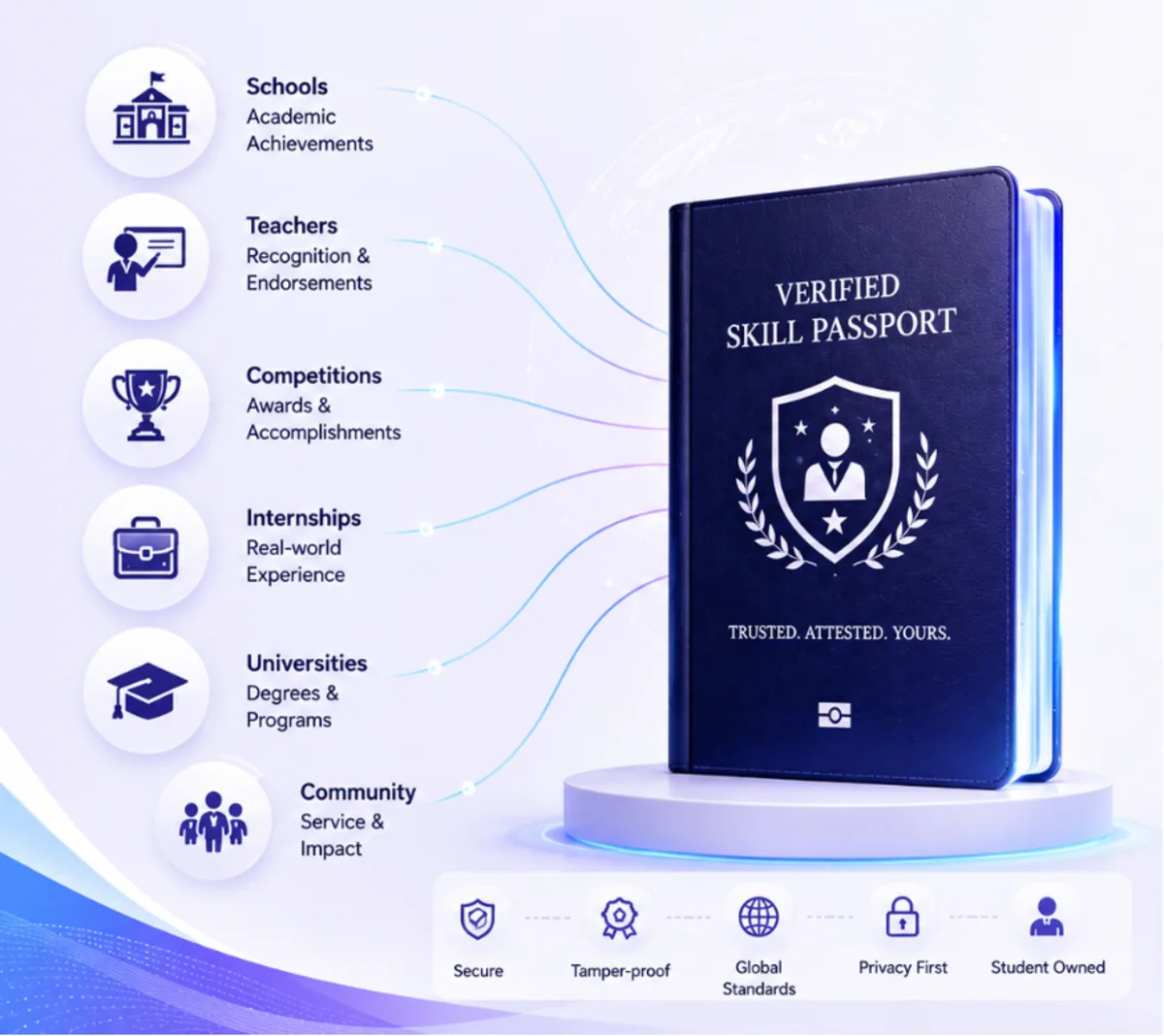
- Academic courses and outcomes
- Individual credentials and Open Badges
- Skills and competencies
- Projects and experiential learning
- Internships and work experience
- Competitions and recognition
- Teacher or mentor attestations
- Evidence supporting achievements
1EdTech describes CLR as designed for digitally capturing and communicating learning experiences and achievements in verifiable form, with mechanisms for transporting CLR and Open Badge credentials between systems under the learner’s control.
What a CLR is not: A CLR is not a portfolio or a self-reported profile. It is an institutionally-issued structured record — created and verified by the school or institution, not assembled by the student themselves.
How the three standards relate to each other
These standards are not competing. They form a layered system:
| Standard | Role | Maintained by |
|---|---|---|
| W3C Verifiable Credentials 2.0 | Provides the cryptographic model for secure, independently verifiable digital credentials | W3C |
| Open Badges 3.0 | Applies the VC model to individual learning achievements with metadata for issuers, criteria and evidence | 1EdTech |
| CLR 2.0 | Bundles multiple achievements (including Open Badges) into a broader, portable learner record | 1EdTech |
Think of it as foundations:
- W3C VC is the concrete — the structural layer that makes everything above it trustworthy
- Open Badges is the brickwork — individual achievements built on that foundation
- CLR is the building — a complete structure assembled from those individual bricks
Key concepts explained
Evidence Documentation that supports an achievement claim. In Open Badges, evidence is an optional but important component. A badge that says “won a robotics competition” is a claim. A badge that includes a link to the team’s design documentation, a video of the final demonstration and a judge’s assessment panel report is evidence.
Issuer The organisation that creates and signs the credential. For schools, this is the school itself. For certifications, it’s the certification body. The issuer’s identity is embedded in the credential and forms part of the verification process.
Learner (Holder) In the Verifiable Credentials model, the learner is the holder — the person who receives credentials from issuers and controls how they are presented to verifiers. This is a meaningful distinction from systems where the institution holds all records and the learner must request access.
Achievement The specific thing the credential recognises — a course completion, a competition result, a demonstrated skill, a project outcome. In CLR, multiple achievements can be bundled together.
Verification The process by which a recipient confirms that a credential is authentic — that it was issued by who it claims, to whom it claims, and has not been altered. Cryptographic signatures in Verifiable Credentials make this independently verifiable.
Endorsement In some credential systems, a third party (a teacher, a mentor, an external organisation) can endorse a credential — adding their validation to the original issuer’s claim. This is distinct from attestation, which is typically a primary verification of the achievement.
Portability The ability of the learner to carry and present credentials independently of the system that issued them. Portability is a design goal of the VC and CLR standards — but see the note on recognition below.
Learner control The degree to which the learner can decide what to share, with whom and when — without requiring the original issuing institution to be involved in each transaction.
What standards provide — and what institutions still decide
This is the most important nuance in the entire ecosystem.
Open standards provide:
- A common format — credentials can be expressed in compatible ways across different systems
- Cryptographic security — credentials can be signed and their authenticity confirmed
- Portability — learners can carry credentials across systems
- Interoperability — different platforms can exchange credential data
Open standards do not provide:
- Automatic recognition — a university’s decision to consider a credential for admissions is a policy decision, not a technical one
- Universal acceptance — no standard can guarantee that every employer or institution will act on every credential
- Quality assurance — a credential expressed in an open standard is not inherently more or less meaningful than the achievement it represents
This distinction matters enormously for education leaders evaluating vendor claims. When a platform says its credentials are “globally recognised” or “accepted everywhere,” that is a claim about institutional policy — not about technical standards.
A more accurate and defensible claim is: “Our credentials are built on open standards that support portability, interoperability and independent verification.”
A comparison of the three standards
| Open Badges 3.0 | W3C VC 2.0 | CLR 2.0 | |
|---|---|---|---|
| Scope | Individual achievement | Credential model | Broader learner record |
| What it contains | Achievement, issuer, criteria, evidence | Claims, issuer, holder, proof | Multiple achievements, skills, experiences |
| Cryptographic security | Yes (via VC) | Yes | Yes (via VC) |
| Learner control | Yes | Yes | Yes |
| Portability | Yes | Yes | Yes |
| Maintained by | 1EdTech | W3C | 1EdTech |
| Guarantees recognition | No | No | No |
Where SkillStory fits
SkillStory’s approach to digital credentials is built on these open standards. The Skill Passport gives learners a structured, portable identity that brings together skills, projects, credentials and verified achievements.
Schools can use the School License to issue structured credentials aligned with these standards — giving students records that travel with them beyond the school environment.
The pieces are now in place. Open Badges, Verifiable Credentials and CLR give schools a complete toolkit for building learner records that are secure, portable and structured.
What they don’t do is make the decision for universities and employers. That decision — whether to recognise, accept or act on a credential — remains a human and institutional one.
The standards make the conversation possible. The rest is up to the people in the room.