
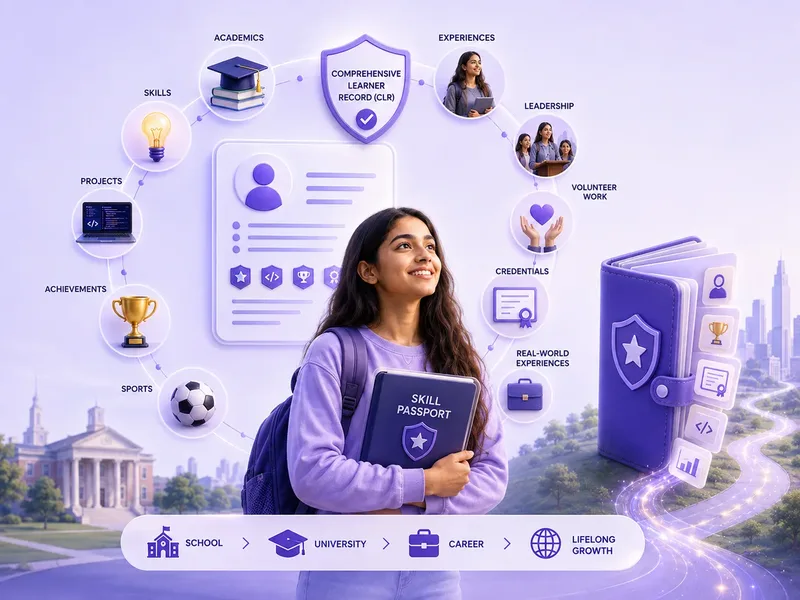
A school may know a student through grades, examination results and attendance. But that same student may also have built a robot, led a club, competed in a debate, played at district level, completed a coding course or worked on a community project.
Where does all of that go?
Often, it ends up in different places: certificates in a folder, competition results in a spreadsheet, project work in an LMS, and teacher recommendations in email.
For school leaders, this raises a practical question:
If a transcript records a student’s academic results, where is the record of everything else they have learned, built and achieved?
That is the problem a Comprehensive Learner Record (CLR) is designed to address.
What is a Comprehensive Learner Record?
A Comprehensive Learner Record is a structured digital record for communicating a learner’s learning experiences and achievements in verifiable form. The current standard is CLR 2.0, maintained by 1EdTech.
The idea is broader than a traditional transcript.
A transcript might tell a university that a student completed certain subjects and achieved particular grades. A broader learner record can provide context around other things the student has learned and demonstrated — skills, competencies, projects, internships, credentials and other achievements.
A CLR is therefore not a replacement for the transcript. It sits alongside the academic record and provides a fuller picture of the learner.
For a school, that distinction matters. The question isn’t whether grades matter. It is whether grades alone describe everything the school has helped a student learn and demonstrate.
Transcript, credential, CLR and Skill Passport: what’s the difference?
These terms are often used together, but they describe different things.
| Record | Primary purpose |
|---|---|
| Transcript | Records formal academic outcomes |
| Digital credential | Represents a particular qualification, achievement or recognition |
| Open Badge | A digital credential containing structured information about an achievement |
| Verifiable Credential | A digitally verifiable way of expressing claims made by an issuer |
| CLR | Brings multiple learning experiences and achievements into a broader structured record |
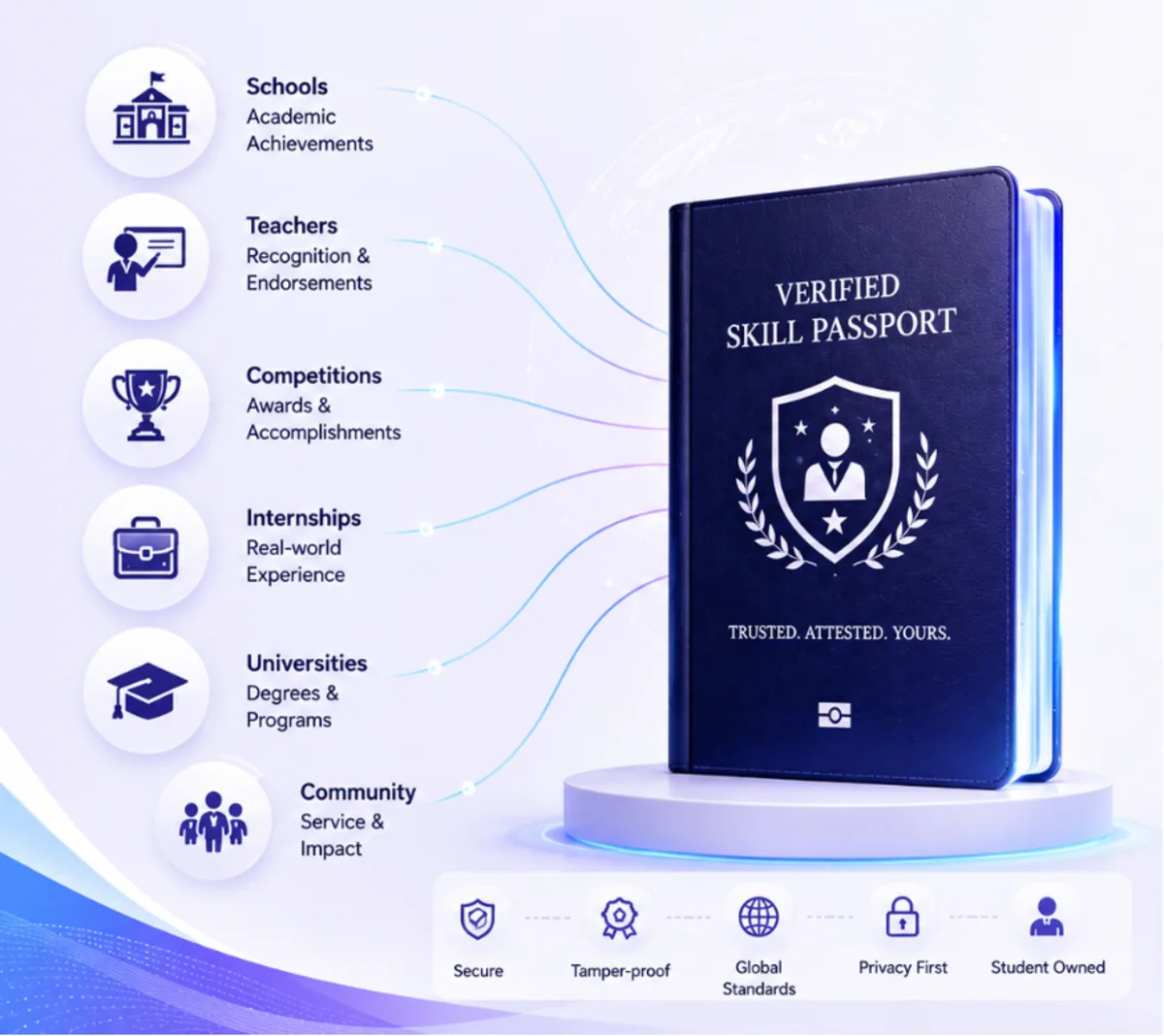
| Skill Passport | A learner-facing experience for bringing skills, evidence, achievements and credentials together |
1EdTech describes an Open Badge as a way of packaging information about a single recognition or achievement, including the issuer, criteria and potentially evidence. Its CLR standard provides a way to communicate broader collections of learning achievements.
W3C’s Verifiable Credentials Data Model defines a verifiable credential as a digitally secured way to express claims made by an issuer, with issuers, holders and verifiers playing distinct roles.
So these aren’t necessarily competing technologies. A school could issue an individual digital credential for an achievement, align that achievement with skills, and have those achievements represented as part of a broader learner record. A Skill Passport can then give the learner a practical way to view and present that record.
What belongs in a learner record?
There isn’t one universal list that every school needs to adopt.
A secondary school focused heavily on academics may structure its record differently from a school with extensive sports, arts, entrepreneurship or vocational programmes.
But a modern learner record might include:
- academic learning
- skills and competencies
- projects
- competitions
- leadership
- sports and arts
- internships and work experience
- certifications
- digital credentials
- evidence
- reflections
- teacher or mentor recognition
The point isn’t to collect everything a student has ever done.
It is to capture meaningful achievements with enough context to understand them.
Consider a simple example.
A school record might say:
Robotics Project — 2026
A richer record could say:
Designed and built an autonomous line-following robot as part of a four-member team. The project involved programming, testing, problem solving and collaboration and was reviewed by the supervising teacher.
The second version tells a future reader much more about what the student actually did.
The problem with fragmented achievement records
Most schools already hold a considerable amount of information about their students.
The difficulty is that the information often lives in different systems.
A student’s academic results may sit in the student information system. Certificates might be stored as PDFs. Competition results could be maintained by individual departments. Project work might live inside an LMS. A teacher may have evidence of a student’s contribution that never makes it into any formal record.
Imagine a student who has spent three years at a school.
They have:
- won a science competition
- led the environmental club
- completed a certified programming course
- played in the school football team
- built two major projects
- volunteered at a community event
At graduation, some of this may be represented by certificates. Some may appear in a recommendation letter. Some may exist only in the student’s memory.
A learner record creates an opportunity to preserve those achievements in a more structured way.
That matters for the student — but it also matters to the school. The school has invested time in creating these learning experiences. A structured record gives the institution a better way to document what students actually did.
A digital certificate is not the same as evidence
Putting certificates online solves only part of the problem.
Suppose a student uploads a certificate saying they won a competition. A future reader may still want to know:
- What was the competition?
- Who issued the recognition?
- What were the criteria?
- What did the student actually do?
- Was there evidence?
- Can the issuer or achievement be verified?
- What skills were demonstrated?
This is where structured credentials become more useful than a folder full of documents.
1EdTech’s Open Badges specification supports achievement metadata such as the issuer, criteria and evidence, while CLR provides a way to communicate collections of achievements.
The distinction is simple:
A file stores information. A structured credential gives that information meaning and context.
Why open standards matter to schools
Technology decisions made by a school can outlast the software vendor that originally supplied them.
A student may spend six years at a school and then move to a university, another country or into employment. The record created during those years should not become useless simply because the school changes systems.
This is one reason open standards matter.
1EdTech’s CLR 2.0 is designed for digitally capturing and communicating learning experiences and achievements in verifiable form. Its ecosystem also provides mechanisms for transporting CLR and Open Badge credentials between systems under the learner’s control.
Open Badges 3.0 is aligned with the W3C Verifiable Credentials Data Model 2.0 and supports verifiable achievement information, including evidence and skill alignment.
W3C’s Verifiable Credentials Data Model 2.0 became a W3C Recommendation in May 2025 and defines a model for credentials that can be cryptographically secured and machine-verifiable.
For a school leader, the practical question is therefore not simply:
“Does this platform have a good dashboard?”
It is also:
“What happens to our students’ records if they leave our system?”
Portable, interoperable, verifiable and recognized are not the same thing
These words are sometimes used as though they mean the same thing. They don’t.
Portable means the learner can carry or present the record outside the system where it was created.
Interoperable means different systems can exchange and work with information using compatible structures and standards.
Verifiable means a recipient can check the authenticity or validity of the credential or its digital proof.
Recognized means a particular institution or organization accepts the achievement for a particular purpose.
Accepted is ultimately a decision made by the receiving organization.
This distinction is important. Open standards can support portability, interoperability and verification. They do not guarantee that every university, employer or government will accept every credential.
That is why a school should be careful about vendor claims such as “globally accepted” or “recognized everywhere.” A more meaningful objective is to create records that are structured, verifiable and designed for portability across systems.
Where skills and taxonomies come in
There is another problem with traditional student records: they often describe activities without describing the skills demonstrated through those activities.
Take the earlier robotics project.
The activity is:
Built an autonomous robot.
But the project may also provide evidence of:
- programming
- problem solving
- collaboration
- communication
- testing
- project management
A skills taxonomy gives schools and other organisations a more consistent vocabulary for describing these capabilities.
ESCO, for example, provides a structured classification of skills, competences and occupations. Its skills pillar contains concepts with descriptions and relationships to other skills and occupations.
The value isn’t that every school needs to use ESCO. Rather, it illustrates an important direction:
Learning → Evidence → Skill → Credential → Learner Record
When skills are described using a structured vocabulary, it becomes easier to connect learning achievements with the language used by universities, employers and workforce systems.
That doesn’t mean a school project automatically qualifies a student for a particular occupation. It means the achievement can be described more precisely.
From school projects to a lifelong record
The real value of a learner record becomes clearer when you stop looking at it as a graduation document.
Consider a student who starts building their record at age 12.
At first it might contain:
School projects → competitions → sports → leadership
A few years later:
Certifications → advanced projects → volunteering → internships
At university:
Research → credentials → internships → professional projects
Later:
Employment → professional certifications → continuing education
The record changes because the learner changes.
That is the important shift: the record becomes longitudinal rather than episodic.
Instead of creating a new profile every time the learner reaches a new stage, the student can continue building on the evidence already accumulated. This is precisely what a Skill Passport is designed to support — a student-owned record that grows from school through university and into career.
What does this mean for a school?
For school leaders, implementing a learner record isn’t primarily about adding another place for students to upload certificates.
The bigger opportunity is to create a consistent approach to recognising learning beyond examination results.
That could mean:
Recognising more of the learner — Projects, leadership, sports, arts, competitions and other meaningful experiences can have a place alongside academic results.
Making achievement easier to understand — A project can be connected to evidence, skills, criteria and recognition rather than simply being listed as an activity.
Giving students continuity — A student can begin building their record at school rather than starting from scratch when they apply to university.
Preserving the school’s contribution — The learning experiences a school creates can remain part of the student’s record even after graduation.
None of these outcomes is automatic. They depend on how the school designs its processes, what it chooses to recognise and how consistently teachers and students use the system.
Ten questions to ask before choosing a learner-record platform
Before adopting a platform, a school or education trust should ask:
- Who owns the learner record?
- Can students take it with them when they leave the school?
- Which open standards does the platform support?
- Can achievements include evidence?
- Can teachers or mentors verify or attest achievements?
- Can credentials be exported or presented outside the platform?
- Can it integrate with the school’s existing systems?
- How are student data and privacy protected?
- How are skills represented and aligned to frameworks?
- What happens to the learner record if the school changes vendors?
The last question is often overlooked.
A school might reasonably expect its student records to remain useful for decades. The technology used to manage them may not. That makes portability and standards a governance question, not simply a technical one.
Where SkillStory fits
For schools exploring this model in practice, SkillStory approaches the learner record through a student-owned Skill Passport.
The Skill Passport brings together areas including:
Skills · Projects · Education · Experience · Achievements · Credentials · Reflections · Endorsements
The platform also supports evidence and teacher or mentor attestation so that selected achievements can carry more context and trust than a simple self-entered claim.
SkillStory’s approach is to bring the learner’s different achievements into one continuing identity that can grow from school through university and into career — rather than treating the learner record as an isolated profile that resets each time the student moves to a new institution.
For schools considering this at scale, SkillStory offers a School License that includes a dedicated admin portal, bulk student onboarding, teacher attestation tools, and custom branding for your institution.
What should the learner record look like after graduation?
A student’s transcript will remain important. So will certificates, qualifications, portfolios and recommendations. But these records answer different questions.
A transcript can show what the student studied and the results they achieved. A credential can recognise a particular achievement. A portfolio can show selected work. A learner record can connect these pieces into a broader history of what the student has learned and demonstrated.
For schools and education systems, the opportunity is to stop thinking of the student record as something that ends when the student leaves the school.
The better question is what the school can help a learner carry forward.
A record that begins with school projects and grows through credentials, skills, experiences and achievements can become much more useful than a folder of certificates sitting in a drive.
And that is ultimately the promise of a comprehensive learner record: not a replacement for the transcript, but a fuller record of the learner behind it.