
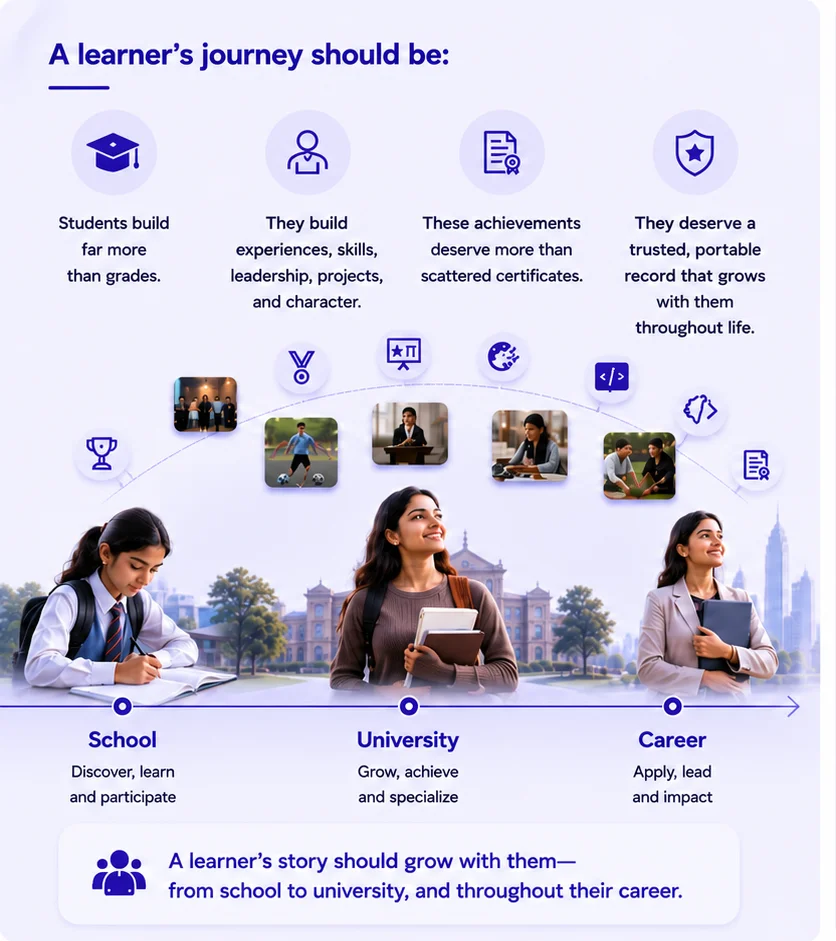
A school’s transcript is important. It records the academic outcomes that universities, parents and students have relied on for generations.
But consider what else a student may have done by the time they graduate.
They may have built projects, won competitions, led a club, played sport, completed certifications, volunteered, participated in internships or developed skills through experiences outside the formal curriculum.
Where is all of that recorded?
Often, it is spread across certificates, school systems, departmental spreadsheets, emails and portfolios.
For school leaders, this raises a bigger question:
Is the transcript enough to represent the learner your school has helped develop?
A transcript records results. A learner record captures more.
The answer isn’t to replace the transcript.
Grades and academic qualifications remain an essential part of a student’s record.
The opportunity is to add the missing context.
A Comprehensive Learner Record (CLR) is designed to communicate learning experiences and achievements in a secure, verifiable digital form. 1EdTech describes its CLR Standard as supporting academic and workplace recognition, including courses, competencies, skills, internships and other achievements. The current standard is CLR 2.0.
For a school, that can mean bringing a broader set of student experiences into a structured record rather than leaving them scattered across different systems.
Think about one student
Imagine a Grade 10 student who has:
- won an inter-school robotics competition
- led the school’s coding club
- completed a recognised programming course
- played competitive basketball
- volunteered at a community initiative
- built an AI chatbot as a school project
The student’s transcript may show strong academic performance.
But it won’t necessarily show the full story.
A richer learner record could connect those experiences to evidence, credentials, skills and recognition.
The difference is not more information for the sake of more information.
It is better context about what the student has actually learned and demonstrated.
What can a modern learner record capture?
There is no requirement that every school capture exactly the same information.
A school may decide to include:
Academic learning Courses, subjects, grades and formal outcomes.
Skills and competencies Capabilities demonstrated through coursework and activities.
Projects Research, engineering, coding, entrepreneurship, art and other applied work.
Experiences Internships, experiential learning and meaningful activities.
Achievements Competitions, awards, leadership, sports, arts and community contributions.
Credentials Certificates, Open Badges and other formal recognitions.
Evidence and recognition Supporting evidence, endorsements or teacher and mentor attestations.
1EdTech’s procurement guidance specifically identifies credentials, badges, skills, competencies, co-curricular achievements, internships and experiential learning among the types of information a CLR can support.
The important point is that the record can be structured around the learner rather than around one particular school system.
The problem isn’t lack of data. It’s fragmentation.
Most schools already collect enormous amounts of student information.
The challenge is that it is often divided between systems.
Academic results may sit in the SIS.
Certificates may be PDFs.
Competition results may be maintained by an activity coordinator.
Projects may live inside an LMS.
Teacher recognition may exist in email.
A student might therefore spend years accumulating meaningful experiences without ever developing one coherent record of them.
That creates a problem when the student needs to present their story outside the school.
A university may see the transcript.
A scholarship provider may see an application form.
An internship provider may see a resume.
But none of those necessarily provides the complete picture.
A learner record can help connect those pieces.
From “what did they study?” to “what did they demonstrate?”
This is where the concept becomes especially useful for modern schools.
Take the robotics example.
A simple record might say:
Robotics Competition — Winner, 2026
A richer record might include:
Built and tested an autonomous robot as part of a four-member team; designed the control logic, tested multiple iterations and presented the final solution to a judging panel.
That second record provides evidence of more than participation.
It gives context around:
- problem solving
- programming
- collaboration
- communication
- project work
The achievement remains the same. The evidence around the achievement is richer.
That distinction matters when a student eventually needs to demonstrate capability rather than simply list activities.
A learner record is not a digital folder
One of the easiest mistakes for schools to make is to think that moving certificates online solves the problem.
It doesn’t.
A folder might answer:
“Does this student have a certificate?”
A structured record can answer much more:
What did the student achieve?
Who issued it?
What were the criteria?
What evidence supports it?
What skills or competencies are associated with it?
Who verified or attested it?
Can another system understand the credential?
1EdTech’s standards are designed around structured achievement information, and CLR can bundle multiple achievement credentials into a broader record.
That moves the conversation from document storage to learner representation.
Why portability should matter to schools
A student may spend six years in one school and then leave.
The learner may move to:
University → another country → scholarship → internship → employment
The school’s systems may change during that period too.
That makes portability an important design question.
1EdTech describes the CLR Standard as an interoperable learner record and provides mechanisms for transporting CLR and Open Badge credential data between systems under the learner’s control.
But there is an important distinction:
Portable does not mean automatically recognized.
A credential can be designed to be portable and verifiable without guaranteeing that every university or employer will accept it.
School leaders should therefore look for systems that support open standards, interoperability and verification, rather than relying on broad claims about universal acceptance.
Open standards are an institutional decision
For a school trust or education group, the technology decision is bigger than a software dashboard.
A learner’s record could remain relevant for decades.
If the data is tied tightly to one proprietary system, changing vendors may create significant migration and continuity problems.
This is why standards matter.
1EdTech’s CLR Standard 2.0 is intended to support secure, verifiable and interoperable learner records. It can work with Open Badges and is compatible with W3C Verifiable Credentials.
W3C’s Verifiable Credentials Data Model 2.0 became a W3C Recommendation in May 2025 and provides a standard model for expressing credentials on the Web in a way that supports cryptographic security, privacy and machine verification.
For schools, the practical question is therefore:
Can our students’ learning records remain useful even when they move beyond our technology environment?
That’s a much more important procurement question than whether a platform has the most attractive interface.
Skills need structure too
A learner record becomes even more useful when achievements can be described in terms of skills.
Consider a student who builds an AI chatbot.
The school could record:
AI Chatbot Project
But the underlying experience may demonstrate:
Programming · Problem Solving · Communication · Collaboration · Research · Project Management
Skill taxonomies and frameworks provide a common vocabulary for describing those capabilities.
For example, the European Commission’s ESCO classification provides structured concepts for skills and competences and connects them with occupations.
A school doesn’t necessarily need to use ESCO.
The broader principle is what matters:
Learning → Evidence → Skills → Credentials → Learner Record
That common language can make student achievements easier to understand across different education and employment contexts.
What does this mean for a school?
A learner record should not become another administrative project that teachers are expected to maintain manually.
The value comes from embedding it into what the school already does.
For example:
When a student completes a project → capture the project and evidence.
When they win a competition → record the achievement.
When a teacher recognizes a capability → provide an attestation or endorsement.
When the school issues a credential → connect it to the learner record.
Over time, these small additions create something much more valuable than a collection of certificates.
They create a longitudinal picture of the learner.
For a school, that can support:
- recognition of learning beyond grades
- richer student profiles
- stronger university-readiness processes
- better documentation of experiential learning
- more meaningful recognition of student achievement
- continuity after graduation
These are opportunities, not automatic outcomes. Their value depends on how the school defines, verifies and uses the records.
What should a principal ask a learner-record provider?
Before choosing a platform, school and trust leaders should ask:
- Who owns the learner record?
- Can the student take it with them after leaving the school?
- Which open standards does the platform support?
- Can achievements include evidence?
- Can teachers and mentors attest to achievements?
- Can credentials be exported or presented elsewhere?
- Can the platform integrate with our existing SIS and LMS?
- How is student data protected?
- How are skills represented and aligned to frameworks?
- What happens to the record if we change vendors?
The last question is particularly important.
A school shouldn’t have to rebuild a student’s history every time its technology stack changes.
Where SkillStory fits
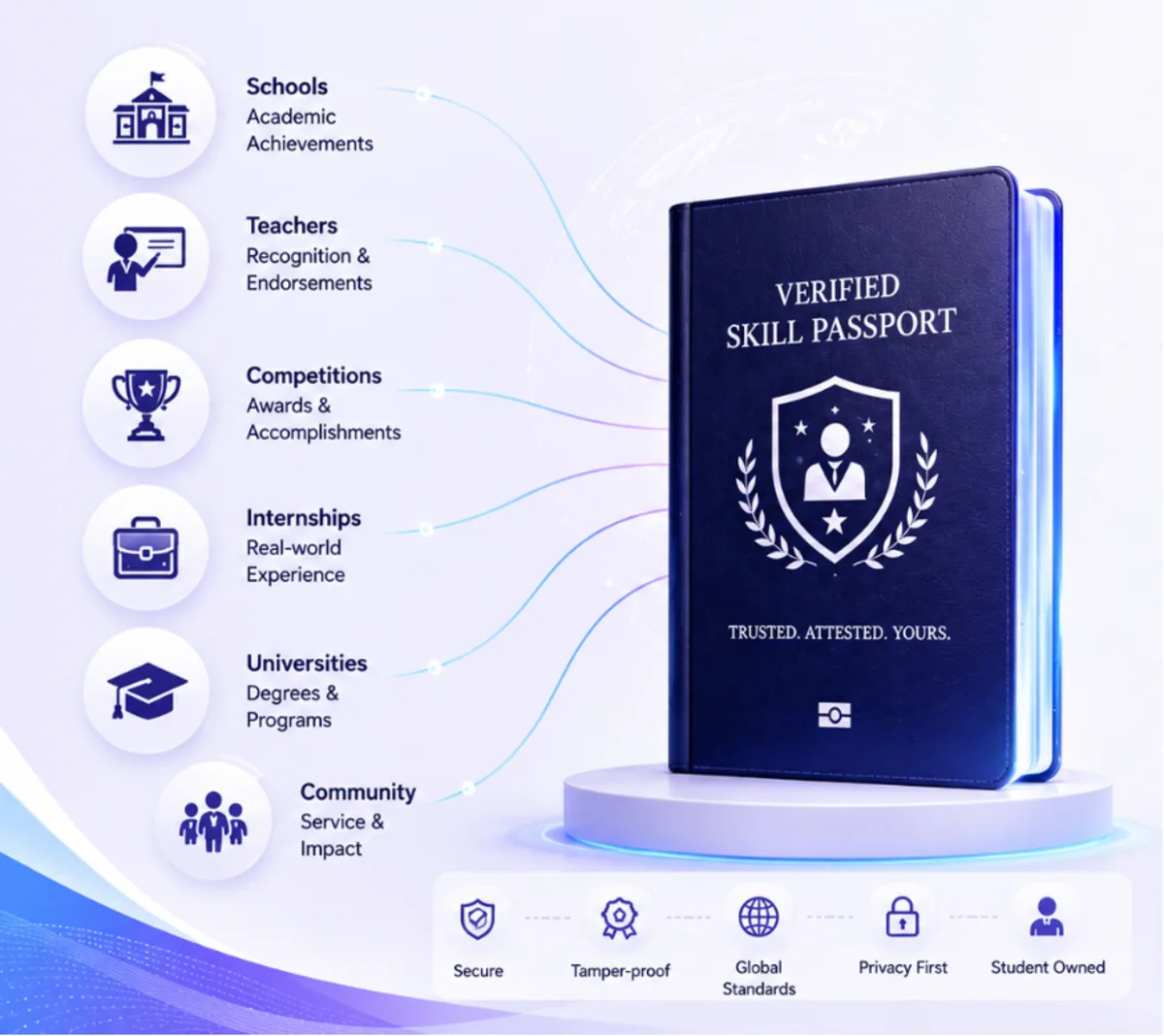
SkillStory approaches this model through a student-owned Skill Passport.
The Passport brings together the different elements of the learner record:
Skills · Projects · Education · Experience · Achievements · Credentials · Reflections · Endorsements
It also adds a trust layer through evidence and teacher or mentor attestation.
The goal isn’t to create another profile for students to maintain.
It is to give them a structured identity that can grow with the learner and provide a practical way to present their capabilities beyond grades.
For schools considering this at scale, SkillStory’s School License includes a dedicated admin portal, bulk student onboarding, teacher attestation tools, and custom branding for your institution.
For the school, the model is straightforward:
The school helps create and verify meaningful learning. The student carries the record forward.
The question schools should be asking now
The transcript isn’t going away.
Nor should it.
But it was designed to answer a fairly specific question:
What did this student study, and how did they perform?
The modern learner may need a record that answers a broader set of questions:
What have they learned?
What can they do?
What have they built?
What experiences have they gained?
What achievements can they prove?
A Comprehensive Learner Record provides a standards-based way to move toward that broader picture. 1EdTech positions CLR as a learner-controlled, interoperable record that can span academic and workplace achievements, including skills, credentials and milestones.
For schools, trusts and education systems, the opportunity is not to replace the academic record.
It is to complete it.
And perhaps the most useful question for a school leader is:
When a student leaves our school, will we have recorded only what they studied — or also what they learned to do?