
When a school selects a student information system, an LMS or a credentialing platform, the conversation often focuses on features, interfaces and pricing.
Rarely does it begin with:
What happens to our students’ records in ten years if this vendor no longer exists?
That question matters more than it might seem.
A student’s learning record — the evidence of their skills, achievements, credentials and experiences — could remain relevant for decades. A transcript issued in 2026 may be presented to an employer in 2046. A digital credential earned this year may need to be verified by a university on the other side of the world.
If those records are locked inside a proprietary platform with no export path, they may become worthless the moment the school changes vendors.
That is the core argument for open standards.
What is vendor lock-in, and why does it matter?
Vendor lock-in occurs when an institution’s data, workflows or records become so tightly integrated with a single vendor’s proprietary system that migrating away becomes prohibitively expensive or disruptive.
In education, this can mean:
- Student records that cannot be exported in a usable format
- Credentials that can only be verified through the original vendor’s platform
- Skills and achievement data that loses meaning outside one system
- A migration project that requires rebuilding years of student history
For a school that plans to use a platform for five to ten years, lock-in may seem abstract. But technology stacks change. Vendors are acquired. Pricing changes. Priorities shift.
Open standards reduce lock-in by ensuring that data can be expressed, exchanged and verified in formats that do not depend on any single vendor’s continued operation.
The three standards that matter most
Three standards have emerged as the foundation of modern digital credentials and learner records.
1EdTech CLR Standard 2.0
The Comprehensive Learner Record Standard, maintained by 1EdTech, is designed for digitally capturing and communicating learning experiences and achievements in verifiable form.
It supports academic and workplace recognition — courses, competencies, skills, internships and other achievements — and provides mechanisms for transporting CLR and Open Badge credentials between systems under the learner’s control.
CLR is designed to bundle multiple achievement credentials into a broader record, and it works alongside Open Badges and W3C Verifiable Credentials.
Open Badges 3.0
Open Badges is 1EdTech’s standard for digital credentials that represent individual achievements. Each badge contains structured information about the achievement, the issuer, the criteria and optionally evidence.
Open Badges 3.0 aligns with the W3C Verifiable Credentials Data Model, which means an Open Badge can function as a verifiable credential — it can be cryptographically secured and independently verified.
W3C Verifiable Credentials Data Model 2.0
W3C’s Verifiable Credentials specification became a W3C Recommendation in May 2025. It defines a standard model for expressing credentials on the web in a way that supports cryptographic security, privacy and machine verification.
In the Verifiable Credentials model, there are three roles:
- Issuer — the organisation that issues and signs the credential (the school, the course provider)
- Holder — the learner who receives and controls the credential
- Verifier — the organisation that checks the credential (a university, employer or scholarship body)
This model gives the learner genuine control: they can present their credentials to any verifier without requiring the verifier to contact the original issuer.
How these standards relate to each other
These three standards are not competing. They work together.
| Standard | What it does |
|---|---|
| W3C Verifiable Credentials | Defines the underlying model for secure, verifiable digital credentials |
| Open Badges 3.0 | Applies the VC model to individual learning achievements with metadata for issuers, criteria and evidence |
| CLR 2.0 | Bundles multiple achievement credentials (including Open Badges) into a broader learner record |
Think of it as layers: W3C VC provides the verifiable foundation; Open Badges builds individual achievement records on top of it; CLR assembles those individual records into a coherent learner history.
Interoperability: what it means in practice
Interoperability means that different systems can exchange and work with information using compatible structures and standards.
For schools, interoperability matters because a student’s learning record will pass through multiple systems over their lifetime:
- A school’s student information system
- An LMS or assessment platform
- A credential wallet
- A university admissions system
- An employer’s hiring platform
If these systems cannot exchange information in compatible formats, the learner has to manually recreate their record at every transition. Evidence gets lost. Context disappears.
Open standards create a common language that systems can use to exchange credential data without requiring point-to-point integrations between every pair of platforms.
Portability, interoperability, verifiability and recognition are not the same thing
These terms are often used interchangeably. They are not.
Portable means the learner can carry and present the record outside the system where it was created.
Interoperable means different systems can exchange and interpret the information.
Verifiable means a recipient can confirm the authenticity of the credential cryptographically.
Recognized means a specific institution has decided to accept the credential for a specific purpose.
Open standards support the first three. They do not guarantee recognition.
A credential can be portable, interoperable and verifiable — and still not be accepted by a particular university or employer. Recognition is a policy decision made by the receiving organisation. Schools and vendors should be careful about conflating technical capability with institutional acceptance.
Data longevity: thinking in decades
Most technology decisions in schools are made with a three-to-five-year horizon.
Student records need to remain useful on a twenty-to-thirty-year horizon.
Open standards address this by separating the credential format from the platform. A credential expressed according to an open standard can potentially be read, verified and interpreted by future systems that don’t yet exist — as long as those systems also support the standard.
A credential expressed only in a proprietary format has no such guarantee.
For school trusts, government education departments and large school groups, this is a governance question. The decision made today about which standards a platform supports will affect whether student records remain useful in the 2040s.
Learner ownership and privacy
Open standards also have implications for learner ownership and privacy.
In the W3C Verifiable Credentials model, the learner is the holder. They receive credentials from issuers and decide when and how to present them to verifiers.
This is meaningfully different from a model where the institution holds all records and the learner must request access.
Learner-controlled records also raise privacy questions. When a learner shares a credential, what information is shared? Can partial disclosure be supported? These are areas where the standards and their implementations continue to develop.
A procurement checklist: 10 questions to ask a digital credential or learner-record vendor
Before selecting a platform, education institutions should ask:
- Which open standards does your platform support — CLR 2.0, Open Badges 3.0 and W3C Verifiable Credentials?
- Can credentials be exported in a standards-compliant format that another system can read?
- Can credentials be verified independently of your platform?
- Who owns the learner record — the learner, the school or the vendor?
- Can the learner present their credentials to third parties without contacting you?
- What happens to student data if we stop using your platform?
- How are credentials signed and what cryptographic methods do you use?
- Can your platform integrate with our existing SIS and LMS?
- How is student data protected and what is your privacy compliance framework?
- What is your approach to standards evolution — how do you handle new versions of CLR or Open Badges?
A vendor that cannot give clear answers to these questions is selling a proprietary product, not an open-standards platform. That distinction matters for a school that expects its students’ records to outlive its current technology stack.
Where SkillStory fits
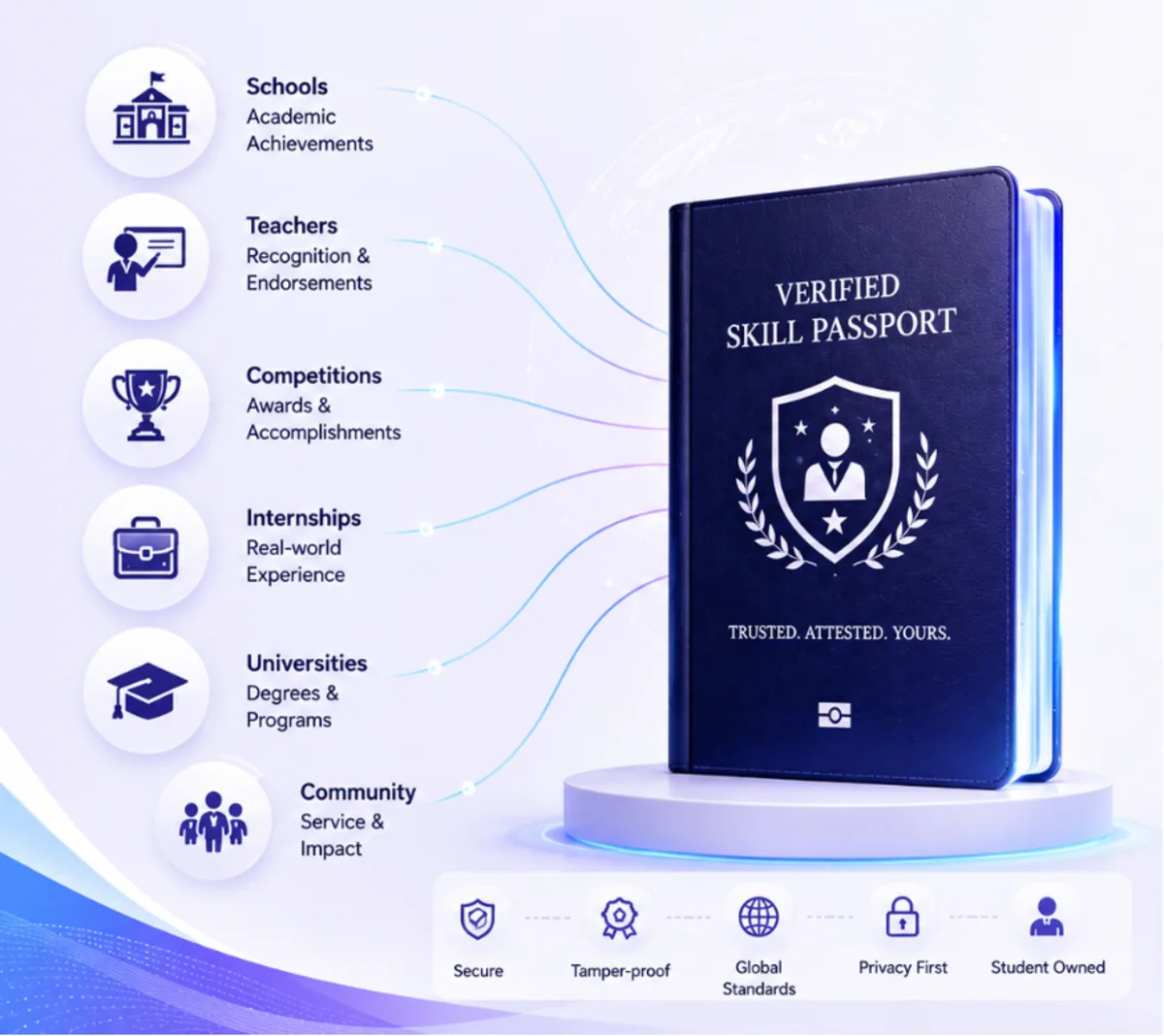
SkillStory builds its credentialing model around the open standards described above. The Skill Passport is designed to give learners a portable, structured record that includes verified achievements, evidence and credentials that can travel beyond the school environment.
For schools exploring this approach at an institutional level, the School License provides a framework for embedding open-standards credentialing into existing school processes.
Open standards are not a guarantee of quality. A platform can claim standards support without implementing it meaningfully. The questions above are designed to help education leaders test those claims before signing a contract.
The transcript will remain important. But it was designed for a different era. The open standards emerging now are designed for a world where learning happens everywhere, records need to travel far, and learners — not institutions — should be the ones who control them.