
Of all the features in the SkillStory Skill Passport, attestation is the one that most fundamentally changes what a student’s record is worth.
Any student can write a list of achievements. A student with teacher-attested achievements has something categorically different: a record that a named, trusted professional has independently confirmed is genuine.
This guide explains how attestation works in SkillStory — for students requesting it, teachers providing it, and schools implementing it.
What Attestation Means in the SkillStory Context
In SkillStory, attestation is a formal digital process by which a trusted adult confirms a student’s achievement.
It is not a reference letter. It is not a comment on a form. It is a cryptographically signed digital confirmation, tied to the educator’s identity, that cannot be altered and can be verified by anyone in the world via a public link.
The result is a record that has the same trustworthiness as a signed legal document — but is readable, shareable, and verifiable as easily as a web link.
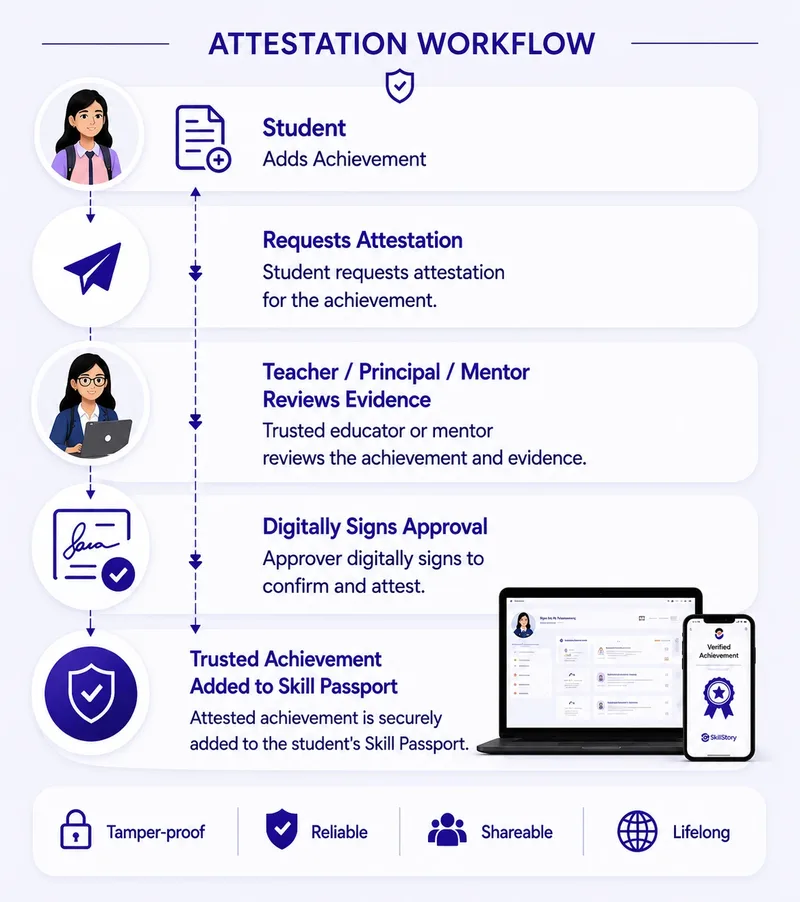
The Attestation Workflow: Step by Step
Step 1 — The Student Logs the Achievement
The student adds an achievement to their SkillStory Skill Passport. This could be:
- A project they completed with measurable outcomes
- A leadership role they held in a school club or team
- A competition they entered and placed in
- A skill they developed with observable evidence
- A volunteering or community contribution
The entry includes a description, dates, and supporting evidence — documents, images, or links that the attesting educator will review.
Step 2 — The Student Requests Attestation
The student selects the achievement and requests attestation from a specific person. They can:
- Choose a teacher from the school portal (if the school is on SkillStory)
- Enter the name and email address of any trusted educator or mentor
The system sends the attesting person an email with a link to review the achievement and the student’s submitted evidence.
Step 3 — The Educator Reviews the Evidence
The educator opens the link and sees:
- The achievement the student has described
- The evidence the student has submitted
- The context (subject, dates, outcome)
The educator does not need a SkillStory account to complete this review. The process is designed to be as straightforward as possible — reviewing the information presented and making a decision.
Step 4 — The Educator Approves or Declines
If the educator is satisfied that the achievement is genuine and accurately described, they sign their digital approval. If they have concerns, they can:
- Decline, with an optional note explaining why
- Return the request to the student to revise
The student sees the response. If declined, they can revise their evidence and re-request, or ask a different eligible attester.
Step 5 — The Achievement Is Cryptographically Sealed
When an educator approves an attestation, SkillStory cryptographically seals the record. This means:
- The achievement description, evidence, and educator’s confirmation are locked
- No one — not the student, not the school, not SkillStory — can alter the attested content
- The educator’s name, role, and the date of attestation are permanently recorded
- A public verification link is generated
Step 6 — Anyone Can Verify
The student’s Skill Passport now includes the attested achievement with a verification link. Any evaluator — a university admissions officer, a scholarship committee, a prospective employer — can follow this link and confirm:
- The exact achievement that was attested
- The name and role of the attesting educator
- The date of attestation
- Cryptographic confirmation that the record has not been altered
No emails to the school. No waiting for a reference to arrive. No uncertainty about whether the document is genuine.
Who Can Attest?
In SkillStory, attestation is not limited to classroom teachers. Any trusted adult with professional knowledge of the student’s achievement is eligible:
| Role | What they can attest |
|---|---|
| Subject teacher | Academic projects, skills demonstrated in class, coursework |
| Form tutor / head of year | Personal development, leadership, character |
| Sports coach | Athletic achievements, team roles, competitions |
| Club supervisor | Extracurricular contributions, leadership |
| Community programme leader | Volunteering, social impact, service |
| Employer / internship supervisor | Work experience, professional skills demonstrated |
| University mentor | Research projects, academic extension work |
| Professional mentor | Skills developed, career-relevant contributions |
The attesting person’s role is displayed on the public verification page, so evaluators understand the context of the confirmation.
What This Means for Teachers
Teachers who attest student achievements through SkillStory are doing something meaningful: providing an independent, durable record of a student’s capability that the student can carry for life.
It takes minutes — not the hours involved in writing a comprehensive reference letter. But the result is more verifiable and more useful to evaluators than a letter, because:
- It is tied to a specific achievement with specific evidence
- It is cryptographically signed and cannot be questioned
- It can be verified instantly without contacting the teacher again
Schools using the SkillStory School License can enable all teachers to attest achievements from the school portal, making the process integrated into the school’s workflow.
What This Means for Schools
For schools, offering teacher attestation through SkillStory is a direct service to students. Every attested achievement is a contribution to that student’s lifelong record — one that helps them with university applications, scholarships, internships, and careers.
Schools that implement SkillStory can:
- Issue CLR-compliant credentials to all students
- Enable teachers to attest achievements in minutes via the school portal
- Provide every student with a verified Skill Passport as part of their school record
- Demonstrate commitment to holistic student development, beyond grades alone
Frequently Asked Questions
Does the attesting person need a SkillStory account? No. Attestation requests are sent by email and include a link that takes the educator directly to the review page. No account creation is required to review and sign an attestation.
Can attestation be revoked? Yes. An attesting educator can revoke an attestation if they discover it was inaccurate or if the circumstances that led to it have changed. When an attestation is revoked, the achievement returns to unattested status in the student’s record — it is not deleted.
Can a student request attestation from someone in another country? Yes. SkillStory is an online platform — attestation requests can be sent to any educator or mentor anywhere in the world, and the review and signing process is fully digital.
What if the attesting educator has retired or left the school? The attestation remains valid. The record preserves the educator’s name, role at the time, and the date of attestation. Historical attestations are not affected by changes in an educator’s current employment.
How does attestation differ from a reference letter? A reference letter is a document that an evaluator must take on trust — they cannot independently verify it. A SkillStory attestation is cryptographically signed to a specific achievement and publicly verifiable by anyone. The evaluator does not need to trust the document — they can verify it.
Key Takeaways
- Attestation is the process that transforms a student’s self-reported claim into trusted, independently verifiable evidence
- The SkillStory attestation workflow is simple for educators: review, approve, and sign — no account required
- Cryptographic sealing means attested records cannot be altered by anyone
- Any trusted adult with professional knowledge of the achievement can attest — not only classroom teachers
- The result is a verification link that any evaluator can follow to confirm the achievement instantly
Dr. James O’Brien specialises in credential frameworks and learner record systems in secondary and post-secondary education.