

The certificate has served schools for generations.
A student completes a course, wins a competition, participates in a programme. The school prints a certificate, signs it, hands it over.
The student puts it in a folder.
And there it stays.
This model was designed for a world where records were physical, institutions were local, and the primary audience for a student’s achievement was a single university in the same country.
That world has changed substantially.
Students now apply to institutions globally. They complete learning across multiple platforms. They develop skills across formal and informal contexts. They compete in national and international environments. They earn credentials from providers the school never met.
And the paper certificate — or its digital equivalent, a PDF — captures almost none of it.
A modern school credentialing strategy starts by acknowledging this gap and then building systematically toward closing it.
Why credentialing is changing
The shift from isolated certificates toward structured learner records is not driven by technology alone. It reflects several converging changes:
The expansion of learning contexts. Learning no longer happens only in classrooms. Online courses, competitions, internships, community projects and experiential learning now contribute meaningfully to a student’s development.
The growth of skills-based evaluation. Universities and employers increasingly want to understand what students can do, not just what qualifications they hold. That requires records that describe skills and provide evidence — not just lists of results.
The emergence of open standards. 1EdTech, W3C and the broader digital credential ecosystem have developed open standards that make it possible to issue, exchange and verify learner records across institutional and national boundaries.
Rising expectations for learner ownership. Students and families increasingly expect to own and control their records — not to be dependent on an institution’s continued willingness and ability to provide them.
The credentialing landscape: 17 components
A mature credentialing strategy for a school trust, private school group, education foundation, ministry or K–12 network should address the following:
1. Digital certificates
The first step beyond paper. A PDF certificate with a QR code or verification link is more useful than a paper one — but it remains a document, not a structured credential. It cannot carry evidence, skills alignment or machine-readable metadata.
2. Open Badges
Open Badges are structured digital credentials that contain the achievement, issuer, criteria and optionally evidence in a portable, verifiable format. Open Badges 3.0 aligns with W3C Verifiable Credentials and supports cryptographic verification.
3. Skills
Which skills does the school want to recognise? Skills need to be defined consistently — not just listed. A structured skills vocabulary (see component 4) is required to make skill recognition meaningful across departments and year groups.
4. Skill taxonomies
A skills taxonomy is a structured vocabulary for describing capabilities consistently. ESCO (European Commission), O*NET (US Department of Labor) and domain-specific frameworks provide reference points. A school does not need to adopt an entire taxonomy wholesale, but it does need a consistent internal vocabulary that ideally maps to recognised external frameworks.
5. Evidence
Documentation that supports achievement claims — project files, assessments, videos, external reviews, supervisor reports. Evidence transforms a listed achievement into a demonstrated one. A credentialing strategy without an evidence layer is still fundamentally a certificate strategy.
6. Attestation
Teacher, mentor and supervisor attestations add a layer of trusted verification to student achievements. An attestation from a teacher who directly observed a student’s leadership of a project carries more weight than the student’s self-reported claim. Attestation workflows need to be practical enough for teachers to use without significant additional workload.
7. Verification
How will recipients verify the credentials the school issues? Open-standards-based credentials can be verified independently — without the recipient needing to contact the school directly. The verification mechanism should be built into the credential from the moment of issue.
8. Comprehensive Learner Records
A Comprehensive Learner Record (CLR) brings together multiple achievements — academic, extracurricular, experiential and credentialed — into a broader structured picture of the learner. 1EdTech’s CLR 2.0 standard provides a format for this that supports learner control and portability.
9. Verifiable Credentials
W3C Verifiable Credentials provide the underlying cryptographic model that makes digital credentials independently verifiable. Open Badges 3.0 and CLR 2.0 both build on this foundation. A platform that claims to issue “verifiable credentials” without aligning to the W3C standard is using the term loosely.
10. Portability
Can students take their records with them when they leave? Portability is a design requirement, not a default feature. It requires credentials to be issued in formats the learner can hold and present independently of the issuing institution’s platform.
11. Interoperability
Can different systems exchange credential data in compatible formats? For a school group with multiple institutions, or for students moving between systems, interoperability determines whether records can travel. Open standards are the mechanism for achieving this.
12. Learner ownership
Who owns the learner record? The school, the vendor, or the learner? Learner ownership is both a philosophical position and a technical design choice. Platforms built on open standards can give learners genuine control over their records. Proprietary platforms typically do not.
13. Privacy
Student records contain sensitive information. A credentialing strategy must address:
- What data is collected and retained
- Who has access to it
- How long it is retained
- Whether learners can selectively disclose information
- Compliance with applicable data protection frameworks (GDPR, PDPA, FERPA, etc.)
14. Governance
Who within the institution is responsible for credentialing? What are the criteria for issuing credentials? Who can attest to achievements? How are disputes handled? Governance is the institutional layer that makes a credentialing system trustworthy rather than inflationary.
15. Vendor selection
The technology platform is not the strategy — it is the tool. Vendor selection should follow strategy, not precede it. The right questions for vendor evaluation are in the checklist at the end of this article.
16. Standards
Which open standards does the institution require vendors to support? At minimum: Open Badges 3.0, W3C Verifiable Credentials Data Model 2.0, and CLR 2.0. Standards compliance should be a procurement requirement, not a marketing claim.
17. Implementation roadmap
A credentialing strategy is not implemented overnight. A realistic roadmap might include:
- Phase 1: Digital certificates with verification links
- Phase 2: Open Badges for specific achievement categories
- Phase 3: Skills taxonomy and evidence layer
- Phase 4: Teacher attestation workflows
- Phase 5: CLR integration and learner-controlled records
- Phase 6: Cross-institution interoperability (for school groups)
The four distinctions that matter most
In evaluating claims from vendors and reading marketing materials, four distinctions are essential:
Portable ≠ Interoperable A credential can be downloadable without being interoperable. Interoperability requires compatible standards, not just file downloads.
Interoperable ≠ Verifiable Two systems can exchange data without either credential being cryptographically verifiable. Verification requires digital signatures and a trust model.
Verifiable ≠ Recognised A credential can be cryptographically secure and still not be accepted by a university or employer. Recognition is an institutional policy decision.
Open standards ≠ Automatic acceptance Supporting open standards is a necessary condition for meaningful portability and interoperability. It is not a sufficient condition for institutional recognition. Schools and vendors should not make claims that conflate the two.
The three standards at the centre
Any serious credentialing strategy for 2026 and beyond should be built on these three specifications:
Open Badges 3.0 (1EdTech) — the standard for individual digital achievement credentials, with structured metadata including issuer, criteria and evidence. Aligned with W3C Verifiable Credentials.
W3C Verifiable Credentials Data Model 2.0 (W3C) — the underlying model for cryptographically secure, independently verifiable digital credentials. Became a W3C Recommendation in May 2025.
CLR 2.0 (1EdTech) — the standard for comprehensive learner records that bundle multiple achievement credentials into a broader, structured, learner-controlled record.
These standards are not competing. They form a layered system: W3C VC provides the trust foundation; Open Badges builds individual credentials on it; CLR assembles those credentials into a complete picture.
20 questions to ask before selecting a learner-record platform
Standards and interoperability
- Which open standards do you support — CLR 2.0, Open Badges 3.0, W3C Verifiable Credentials 2.0?
- Can credentials be verified independently of your platform?
- Can credentials be exported in a machine-readable, standards-compliant format?
- How do you handle upgrades when new versions of these standards are released?
- Can your platform integrate with our existing SIS, LMS and assessment tools?
Learner ownership and portability
- Who legally owns the learner record — the learner, the school or your company?
- Can learners export and hold their own credentials without accessing your platform?
- Can learners present credentials to third parties without your platform being involved?
- What happens to student records if we end our contract with you?
- Can students continue to access their records after leaving the school?
Evidence and verification
- Can credentials include evidence — project files, links, assessments, multimedia?
- Can teachers and mentors attest to student achievements through your platform?
- How is the authenticity of credentials cryptographically secured?
- Can a university or employer verify a credential without a user account on your platform?
Privacy and data
- Where is student data stored and what jurisdiction governs it?
- What is your data retention policy?
- How do you handle requests from learners or parents to delete or correct data?
- What data protection certifications or compliance frameworks do you hold?
Governance and support
- What controls do we have over which staff can issue and attest credentials?
- What is your implementation support model — how do you help schools build the internal processes to make credentialing work?
What this is not
A credentialing strategy is not:
- A way to guarantee university placement or employment
- A replacement for academic rigour or examination results
- A marketing tool for the school, divorced from genuine learning recognition
- A bureaucratic layer that increases teacher workload without improving student outcomes
A credentialing strategy done well is a commitment to documenting what students learn, providing evidence for it, and giving students records they can use throughout their lives.
Where SkillStory fits
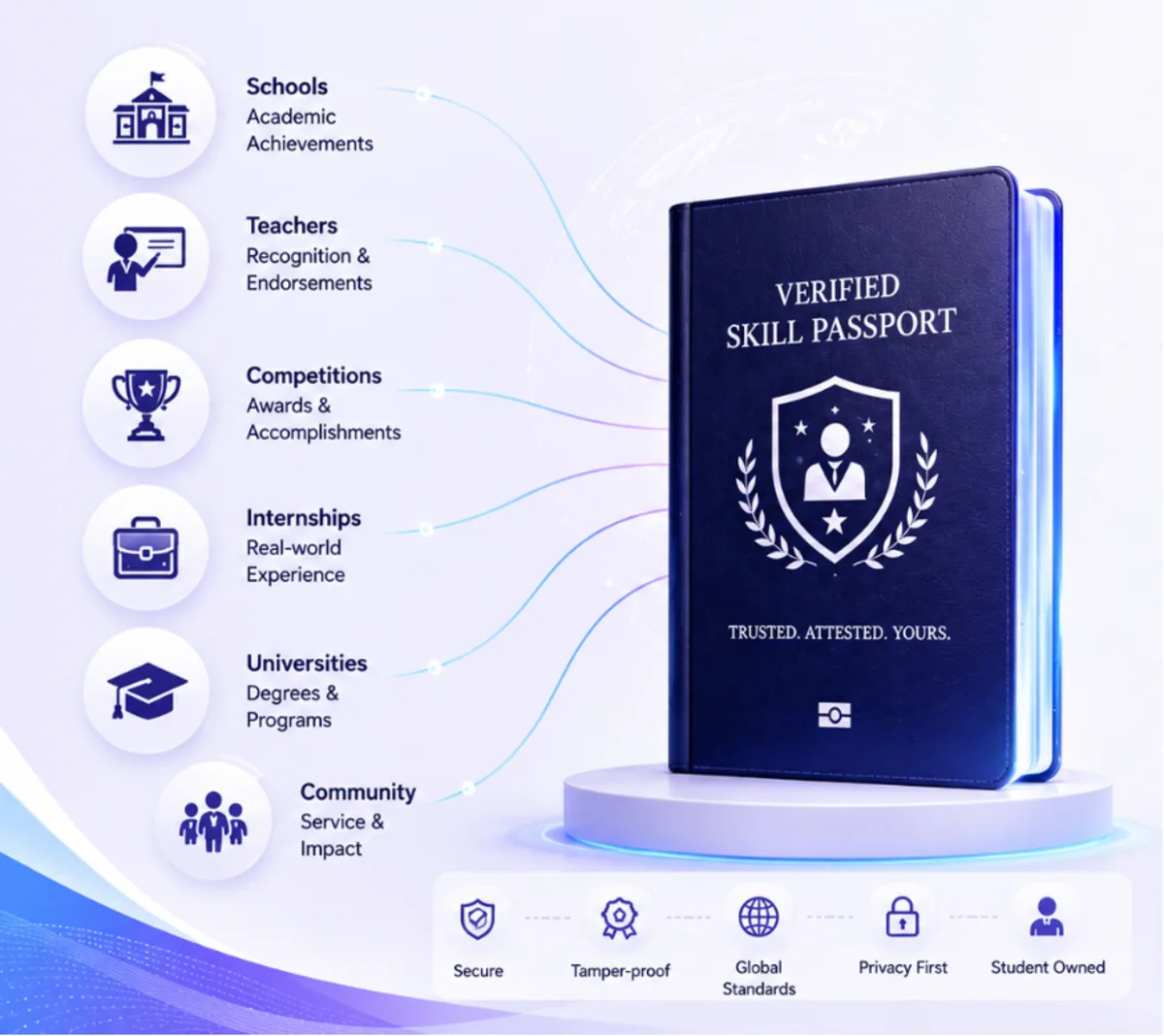
SkillStory approaches this landscape through a student-owned Skill Passport — a structured learner identity that brings together skills, projects, credentials, experiences, attestations and evidence.
For schools building an institutional credentialing approach, SkillStory’s School License provides the operational layer: bulk student onboarding, teacher attestation workflows, a dedicated admin portal and custom institutional branding.
The platform is designed for schools that want to move beyond certificates toward a structured, evidence-based learner record — without requiring teachers to adopt new administrative burdens.
Closing: strategy before technology
The most important recommendation in this guide is the simplest:
Define your strategy before you select your platform.
A school group that knows why it is implementing a credentialing system, what it wants to recognise, who owns the records and which standards it requires will make a much better vendor selection than one that starts by evaluating user interfaces.
The technology is now mature enough to support a serious credentialing strategy. Open standards exist. Digital credential ecosystems are growing. Learner-controlled records are achievable.
What remains is the institutional will to define what student achievement means, document it rigorously, and give students the records they deserve.